
South Carolina Property Records
South Carolina property records are public documents held by the Register of Deeds or Clerk of Court in each of the state's 46 counties. These records include deeds, mortgages, plats, liens, and other instruments that affect real estate ownership. You can search property records online through the statewide SC Land Records portal, through individual county websites, or in person at your local recording office. This guide covers how to find, access, and understand property records across South Carolina.
South Carolina Property Records Quick Facts
South Carolina Property Records System
South Carolina divides the state into 46 recorder districts, one for each county. Each district has an elected or appointed official who is responsible for receiving, indexing, and storing property documents. Under Section 30-5-10 of the South Carolina Code of Laws, 24 counties operate a separate Register of Deeds office. Those counties are Aiken, Anderson, Beaufort, Berkeley, Charleston, Cherokee, Chesterfield, Clarendon, Colleton, Dorchester, Florence, Georgetown, Greenville, Horry, Jasper, Kershaw, Lancaster, Lexington, Oconee, Orangeburg, Pickens, Richland, Spartanburg, and Sumter. In the remaining 22 counties, the Clerk of Court handles all recording duties alongside their court responsibilities.
When a deed, mortgage, or other property document is presented for recording, the office assigns it a sequential identifying number known as a reel and page number. The document is then scanned into the county computer system. Copies of the scanned images are available for viewing at public access terminals inside each county office. All offices also retain microfilm of every recorded document as a permanent historical record. In most cases, the original paper document is returned to the landowner after scanning is complete. The South Carolina Association of Counties supports county governments in managing these responsibilities and maintaining consistent standards across all 46 recording districts.
Every county office creates a searchable index that contains the names of all parties to each recorded document along with a short legal description of the property. This index is the primary tool for locating records. Title companies, attorneys, and the general public rely on this index when researching the ownership history of a parcel. The index links each entry to the scanned document image, allowing researchers to view the full text of any recorded instrument.
The South Carolina Judicial Branch also holds records tied to real property, including foreclosure proceedings handled by the Master-in-Equity courts and probate court records that document property transfers through estates. These court records overlap with property records when ownership changes through legal proceedings rather than standard sales.
How to Search Property Records in South Carolina
The fastest starting point for most searches is the statewide SC Land Records portal. This website links directly to the county recording offices across South Carolina. You select a county from the list, and the system takes you to that county's searchable index. You can look up records by grantor name, grantee name, document type, date range, or parcel number depending on which county you are searching. The portal is free to use for basic index searches, though some counties charge fees for viewing or printing full document images.
The statewide SC Land Records portal provides access to recorder offices across South Carolina.
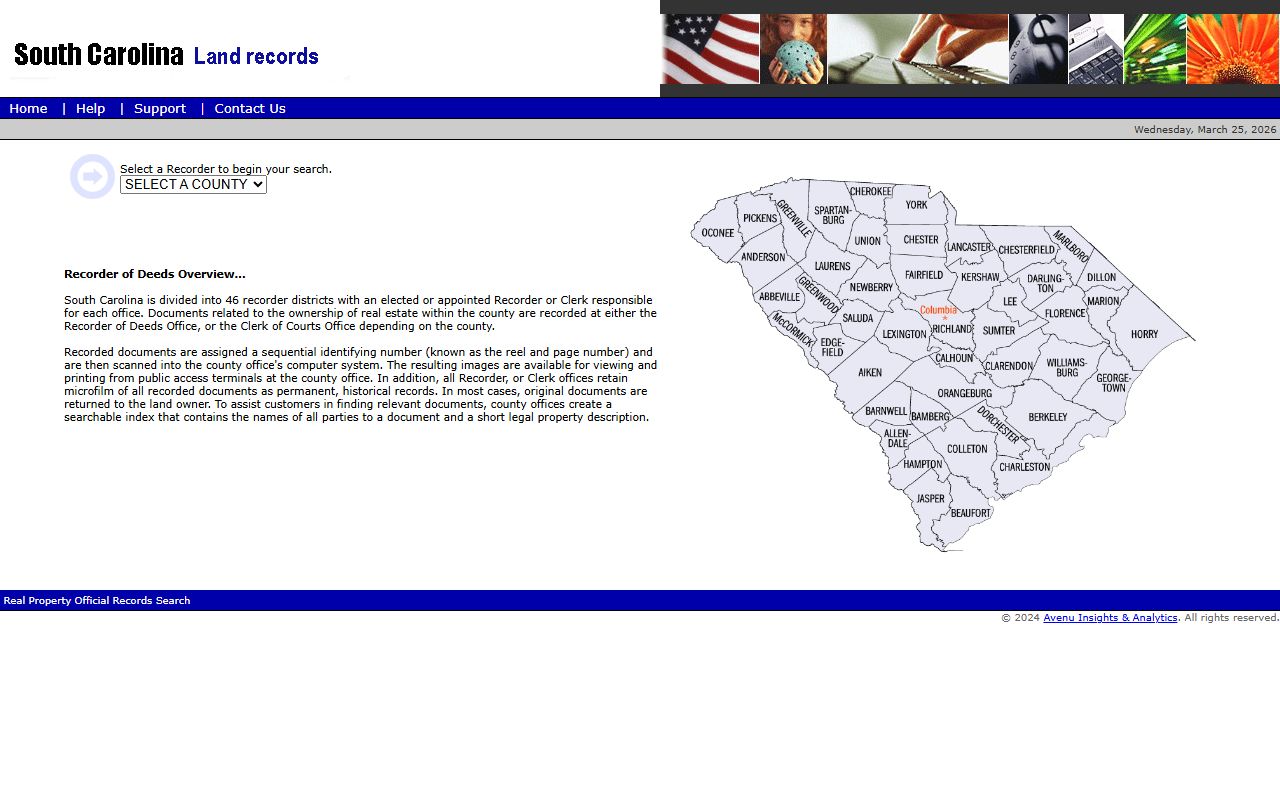
The SC Land Records portal links to all 46 county recording offices and lets you search by party name or legal description.
In-person searches remain the most thorough option for complex title work. You can visit any county Register of Deeds or Clerk of Court office during business hours and use the public access terminals at no charge. Staff can direct you to the right indexes and document books, though they cannot conduct searches on your behalf or provide legal advice about what you find. For records not yet digitized or for very old documents, in-person inspection may be the only way to review the original instrument.
Note: The SC Land Records portal does not host document images directly. It links you to each county system, and image availability varies by county and date range.
South Carolina Deed Recording Fees
South Carolina imposes a Deed Recording Fee on all real estate transfers. The South Carolina Department of Revenue administers this fee and provides guidance to the county offices that collect it.
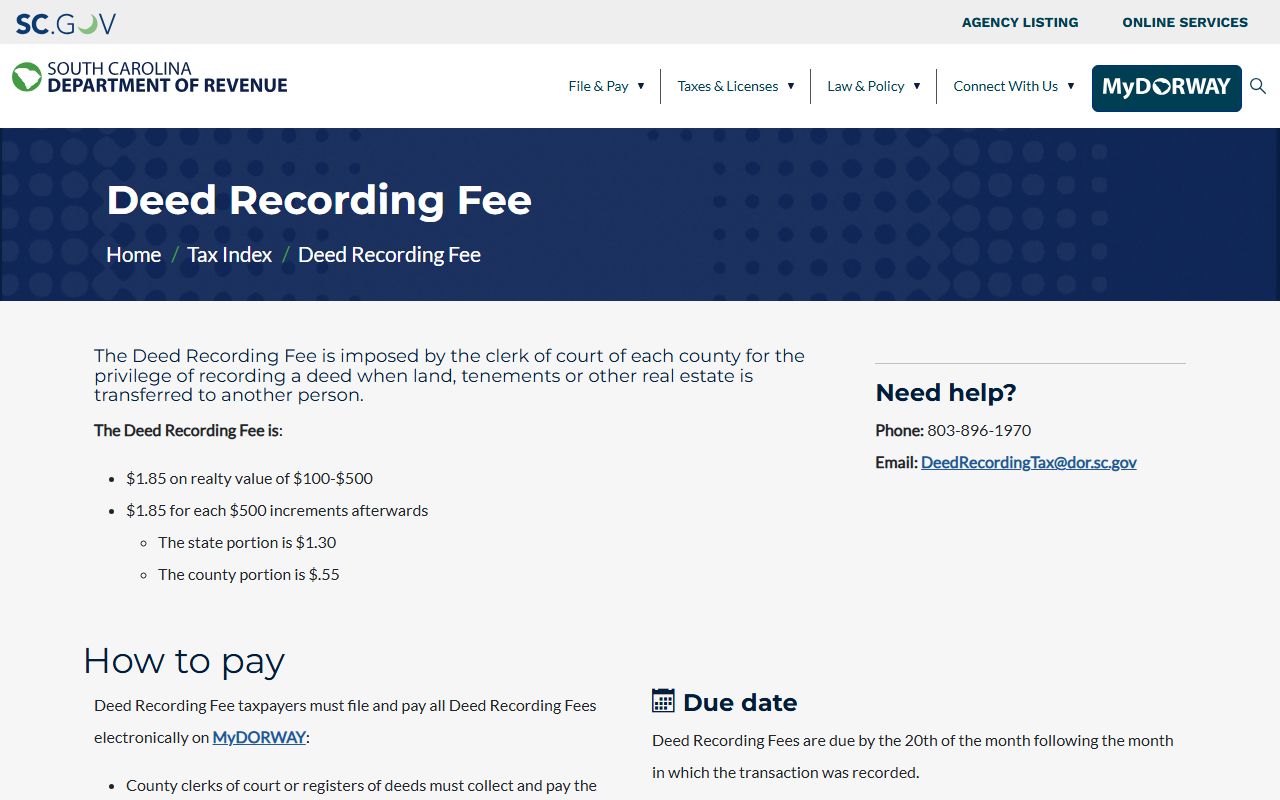
The SCDOR deed recording fee page explains the calculation method, exemptions, and the monthly remittance process for county recording offices.
The fee is calculated at $1.85 for every $500 of the realty value transferred, starting at values between $100 and $500. The total fee is split between the state and the county: the state keeps $1.30 of each $1.85 collected, while the county retains $0.55. County clerks of court and registers of deeds collect this fee at the time of recording and must remit the state's share monthly through the MyDORWAY electronic filing system. Payments are due by the 20th of the month following the month in which the transactions were recorded.
The SCDOR issued SC Revenue Ruling #17-5, a 39-page guidance document in question and answer format that covers virtually every scenario involving the deed recording fee. The ruling addresses how to calculate the fee on complex transactions including gifts between family members, transfers involving limited liability companies, conservation easements, 1031 exchange transactions, foreclosure sale deeds, bankruptcy transfers, and government deeds. Anyone involved in recording deeds in South Carolina should be familiar with this ruling.
Recording Requirements for South Carolina Deeds
Title 30 of the South Carolina Code of Laws sets the rules for recording property documents. The SC Code Title 30, Chapter 5 is the primary legal authority covering what must appear on a deed and how the recording process works.
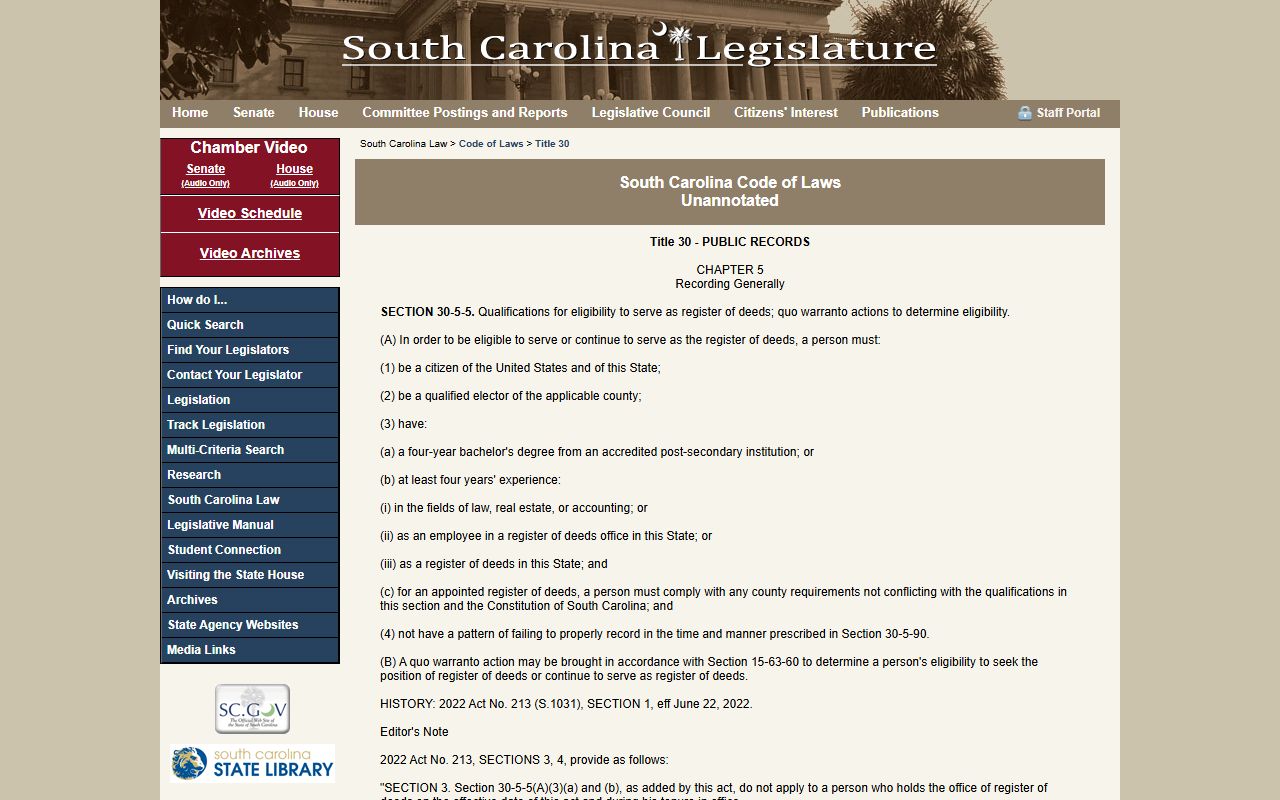
Title 30, Chapter 5 of the SC Code of Laws covers all recording requirements including acknowledgment, derivation clauses, and the 30-day recording timeline.
Section 30-5-30 states that before any deed or other written instrument can be recorded, it must be acknowledged or proved. Acceptable methods include an affidavit from a subscribing witness or acknowledgment before an officer who is competent to administer oaths. This requirement ensures that the signatures on recorded documents are verified before the instruments enter the public record.
Section 30-5-35 added a further requirement for deeds executed after July 1, 1976. Every deed conveying an interest in land and every mortgage of real estate must include a derivation clause in the property description. The derivation clause identifies the previous recorded instrument from which the grantor obtained title. The same section also requires that the mailing address of the grantee or mortgagee be inscribed on the face of the document. These two requirements protect the chain of title and make it easier to trace ownership history through the county indexes.
Section 30-5-90 requires the recording office to record all instruments in the order they are received. Every document must be recorded within 30 days after it is lodged with the office. This rule prevents backlogs from delaying the public record and ensures that newly filed documents become part of the searchable index in a timely manner.
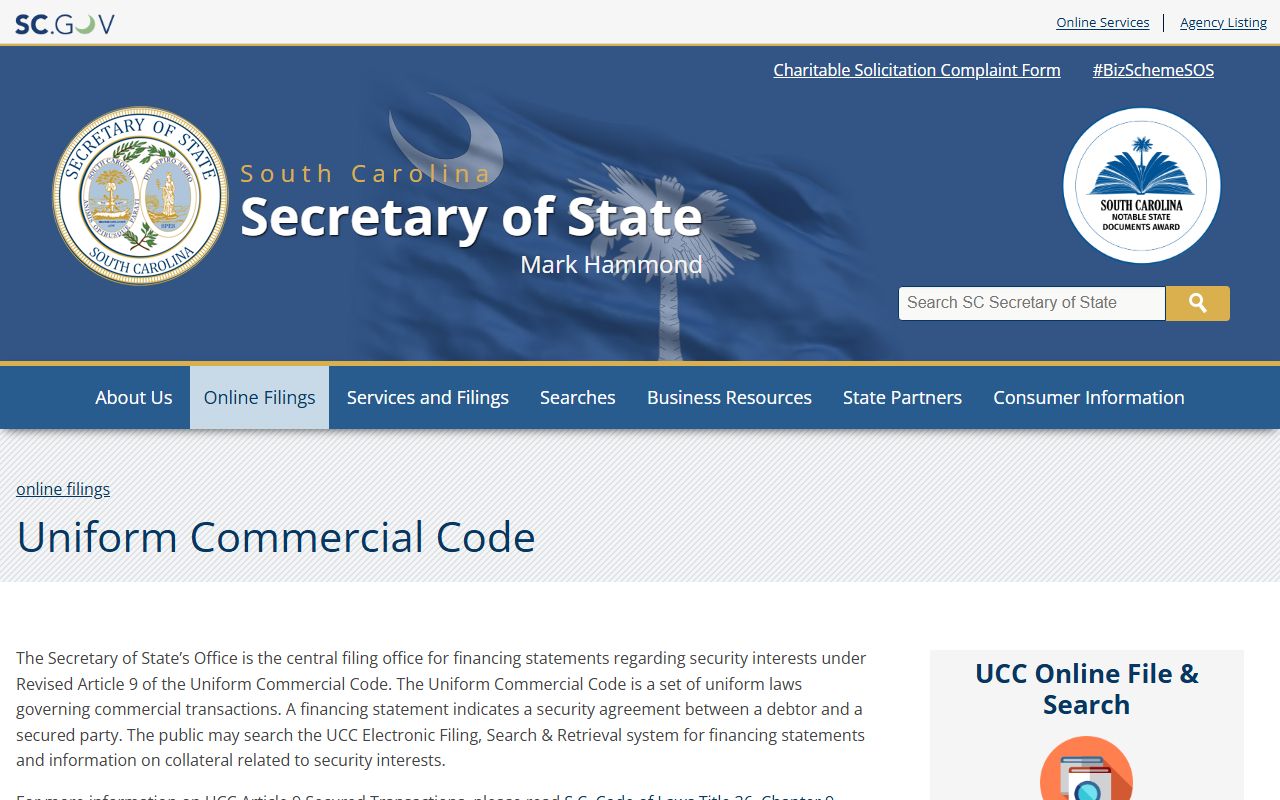
The SC Secretary of State handles UCC financing statements secured by personal property, while county recording offices handle UCC filings secured by real estate.
Uniform Commercial Code financing statements are a separate category of document. The SC Secretary of State's UCC division serves as the central filing office for financing statements related to security interests in personal property under Revised Article 9. After July 1, 2001, only UCC filings secured by real estate are filed at the county Register of Deeds level. The Secretary of State's UCC Electronic Filing, Search and Retrieval system is free to search and allows both filing and retrieval of financing statements online.
For counties along the North Carolina border, Section 30-5-270 addresses a special situation created by the 2017 state boundary clarification. Registers of deeds in the affected border counties, which include Oconee, Pickens, Greenville, Spartanburg, Cherokee, York, Lancaster, Chesterfield, Marlboro, Dillon, and Horry, must file a Notice of State Boundary Clarification for any land affected by the revised state line. This notice alerts title researchers to check records in both states when researching affected parcels.
Property Assessment and Tax Records in South Carolina
Title 12, Chapter 37 of the South Carolina Code of Laws governs property tax assessment across the state. South Carolina uses different assessment ratios depending on how the property is used. Owner-occupied residences are assessed at 4% of fair market value. Agricultural property also carries a 4% ratio. All other real property, including commercial buildings and second homes, is assessed at 6%. Industrial and manufacturing property is assessed by the SCDOR at 10.5% but then receives reductions that bring the effective rate to 6.5%.
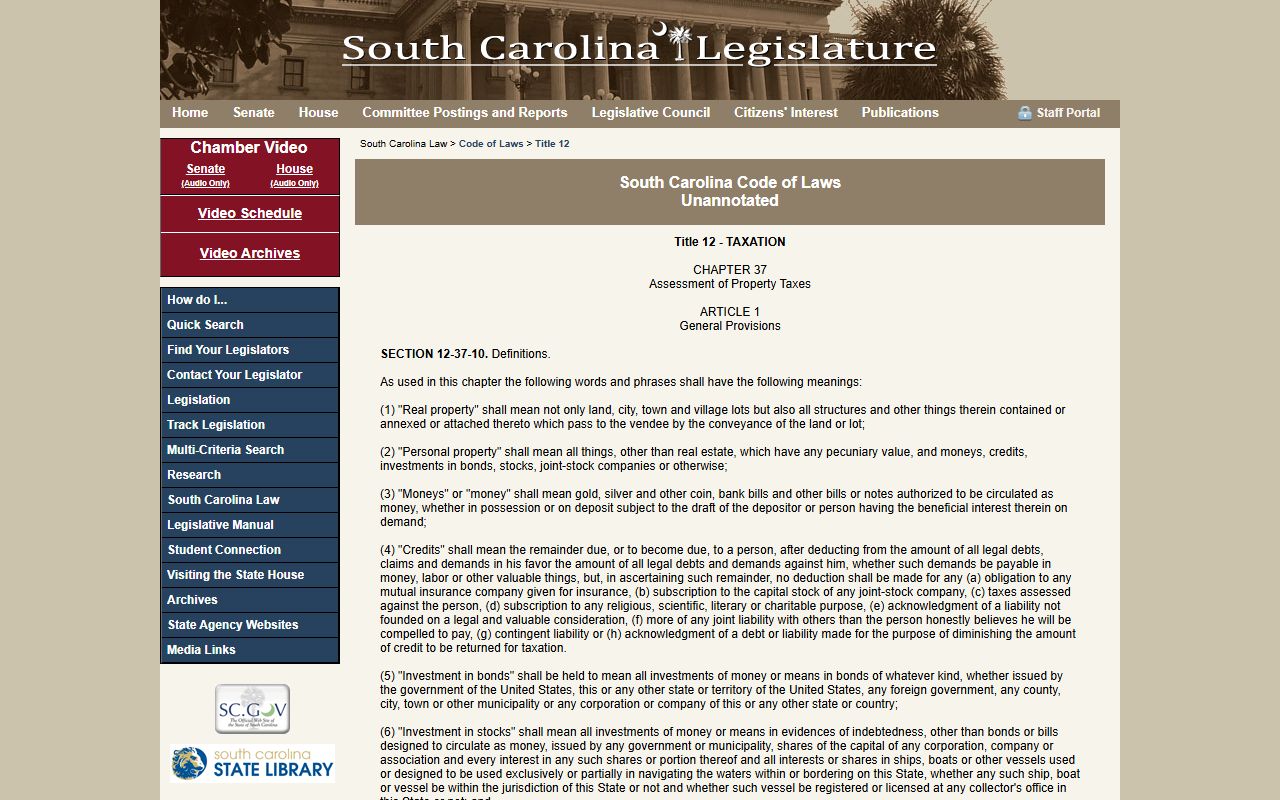
Title 12, Chapter 37 sets the assessment ratios and reassessment schedule that determine how much property owners pay in annual taxes.
South Carolina law requires each county to conduct a countywide reassessment every five years, with a one-year extension available by county ordinance. Act 388 of 2006 capped the taxable value on a real estate parcel at no more than a 15% increase between reassessments, provided the property has not been sold or transferred. When a property does change hands after December 31, 2006, and meets the criteria of an Assessable Transfer of Interest (ATI), the property is placed on the tax rolls at full fair market value in the year following the transfer. This means buyers should expect their property tax bill to reflect current market value rather than the prior owner's capped assessment.
Property tax records are maintained by the County Assessor in each of the 46 counties, separate from the deed recording system. The Assessor sets valuations, maintains assessment rolls, and handles appeals. Tax bills are generated by the County Auditor and collected by the County Treasurer. Many counties make assessment records and tax payment history available online through their county websites.
Historical South Carolina Property Records
The South Carolina Department of Archives and History holds the oldest property records in the state. The department is the repository for state land grants, colonial plat books, and records dating back to the Lords Proprietors era.
The SC Department of Archives and History maintains Colonial Plat Books from 1731 through 1775 and State Plat Books from 1784 through 1868, which are essential for historical title research.
The Surveyor General's records held by the Archives include the Colonial Plat Books covering 1731 to 1775 and the State Plat Books covering 1784 to 1868. These volumes document the original land grants issued by the Lords Proprietors and later by the State of South Carolina. The South Carolina Constitution of 1790 required the Surveyor General to maintain offices in both the new capital at Columbia and in Charleston. The Surveyor General began recording plats in a separate Columbia set of volumes in 1796. All earlier plats, back to 1784, were recorded in the Charleston volumes. Researchers tracing very old title chains often need to consult both sets to find the original grant for a piece of land.
For more recent historical records, microfilm copies of all recorded deeds and mortgages are retained by each county recording office as a permanent archive. These microfilm records serve as backup copies in the event of damage to digital systems and provide an unbroken record of property transfers at the county level.
Note: The SC Archives reading room in Columbia is open to the public, but researchers should contact the department before visiting to confirm current hours and access procedures.
Types of Recorded Property Documents
South Carolina recording offices maintain many types of documents beyond the basic deed. Understanding what is recorded helps researchers know where to look for specific information about a parcel.
Deeds are the most common recorded instrument. A warranty deed guarantees clear title to the buyer. A quitclaim deed transfers whatever interest the grantor holds, without warranty. A trustee deed transfers property out of a trust. Executor and administrator deeds handle estate transfers. A sheriff's deed results from a foreclosure sale. Each deed type serves a distinct purpose in real estate transactions across South Carolina.
Mortgages and deeds of trust secure loans against real property. When a lender makes a real estate loan, the mortgage is recorded in the county where the property sits. Mortgage assignments, partial releases, and full satisfactions are also recorded as the loan progresses. Plats and surveys show the boundaries of a parcel and are recorded when land is subdivided or when a new survey is completed. Mechanic's liens, judgment liens, and HOA liens are recorded when creditors assert claims against property. Powers of attorney affecting real estate transactions must be recorded to be effective against third parties. The SC Association of Counties notes that each county office indexes all of these document types so the public can search by name or parcel.
The SC Association of Counties provides guidance and resources for county governments managing property records across all 46 South Carolina counties.
- Warranty deeds, quitclaim deeds, and trustee deeds
- Mortgages, deeds of trust, and home equity instruments
- Plats, subdivision maps, and boundary surveys
- Mechanic's liens, judgment liens, and tax liens
- UCC filings secured by real estate
- Powers of attorney for real estate transactions
- Mortgage satisfactions and lien releases
The SC Judicial Branch maintains court records for foreclosure cases, probate proceedings, and other legal actions that affect property ownership in South Carolina.
What South Carolina Property Deeds Contain
Knowing what information appears in a deed helps researchers confirm they have found the right document. South Carolina deeds name the grantor and the grantee, identify the property with a legal description, state the consideration paid, and give the date of transfer. The legal description is the precise boundary description of the parcel, not just a street address. It may reference lot numbers in a recorded subdivision plat, metes and bounds measurements, or both.
The derivation clause required under Section 30-5-35 identifies the deed or other instrument by which the grantor previously acquired title. This clause creates a direct link to the prior recorded document, allowing researchers to follow the chain of title backward through the county index. The grantee's mailing address must also appear on the face of the deed. The document must carry the grantor's signature, the signatures of two witnesses, and a notarial acknowledgment. The preparer's name and address are typically noted as well. After recording, the county stamps the deed with the book and page reference where it is filed, and that reference becomes the key identifier for locating the instrument in the future.
The SC Land Records portal at sclandrecords.com provides a good starting point for finding these recorded instruments by address or owner name across South Carolina.
Searching County Property Records Online
Many counties in South Carolina have built their own online search systems in addition to the statewide SC Land Records portal. Charleston County operates one of the most detailed systems in the state. The Charleston County Real Property Record Search allows searches by owner name, PIN, street address, or mailing address. Users can view ownership details, assessed values, tax bills, and links to scanned deed images. The system supports wildcard searches, making it easy to find records when you are unsure of a full name or address.
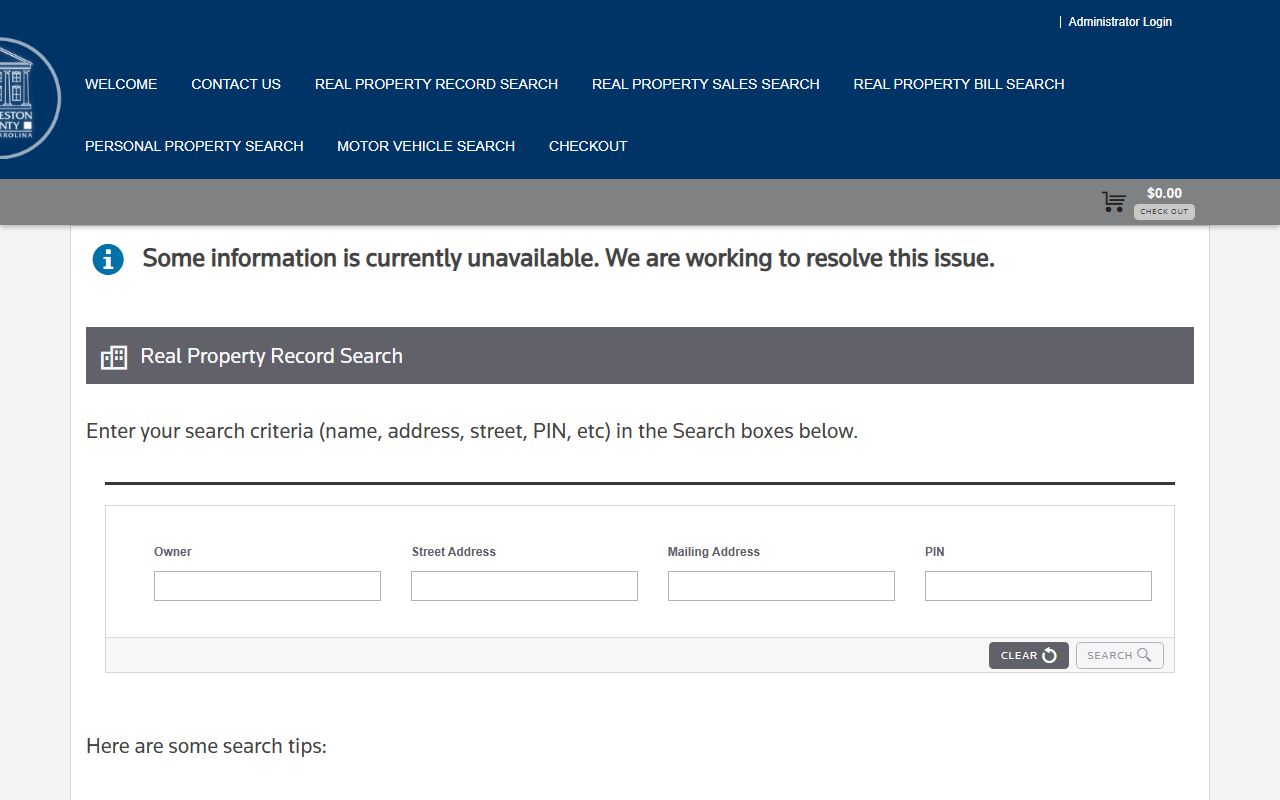
Charleston County's real property search system lets users look up ownership records, tax assessments, and scanned deed images by owner name, PIN, or street address.
Greenville County offers free online access through its Register of Deeds Public Records Search at greenvillecounty.org/rod, and also provides online certification for documents. Richland County's Register of Deeds at 1701 Main Street in Columbia offers subscription-based online access by day, week, month, or year for attorneys, title researchers, and others who need regular access. Horry County maintains over 624,000 deed documents dating back to 1989 and over 378,000 mortgage documents going back to 2002, all available through its online land records system. Beaufort County recently upgraded to a Cloud Search system and also offers a property fraud alert service that notifies owners when documents are recorded against their property.
Note: Online search systems vary by county. Some require registration or charge fees for image access. Contact the county office directly to confirm current access options and any associated costs.
Browse South Carolina Property Records by County
Each of the 46 counties in South Carolina maintains its own property records through either a Register of Deeds or Clerk of Court. Select a county below to find local recording office contact information and resources for property records in that area.
Browse South Carolina Property Records by City
City residents access property records through the county courthouse where their city is located. Select a city below to find information about property records for that area.