
Search Charleston Property Records
Charleston property records are maintained by the Charleston County Register of Deeds. Charleston is the largest city in South Carolina and carries one of the most complete sets of property records in the state, with deeds dating back to 1719. The Register of Deeds keeps all deed transfers, mortgages, plats, liens, and easements for Charleston properties. Whether you are buying a home, researching title history, or verifying ownership, the county office and its online systems give you direct access to Charleston property records without fees for basic searches.
Charleston Quick Facts
Where to Find Charleston Property Records
The Charleston County Register of Deeds is the primary office for all Charleston property records. The office records and maintains deeds, mortgages, plats, and other instruments related to real property in Charleston County. It has kept records for the City of Charleston since 1719, making it one of the oldest continuous recording offices in the United States. Staff can look up records by owner name, parcel number, or address.
| Office | Charleston County Register of Deeds |
|---|---|
| Address | 101 Meeting Street, Suite 150 Charleston, SC 29401 |
| Phone | (843) 958-4800 |
| Hours | Monday through Friday, 8:30 AM to 5:00 PM |
| Website | charlestoncounty.org/departments/register-of-deeds |
The office is in downtown Charleston near the historic district. When visiting in person, bring a valid photo ID. Records from the eighteenth and nineteenth centuries are indexed by surname, while twentieth and twenty-first century records are indexed by geographic location. Staff can assist with both sets of indexes.
The City of Charleston also maintains property-related records at its Permit Center, located at the Gaillard Center, 2 George Street. The Permit Center is open Monday through Friday from 9:00 AM to 2:00 PM. You can reach it at 843-577-5550. The Permit Center holds Board of Architectural Review (BAR) property files, survey cards, and 1929 Sanborn Maps. These records are most useful for historic district properties in Charleston.
The screenshot below shows the City of Charleston government website, which links to permit and zoning records for Charleston properties.
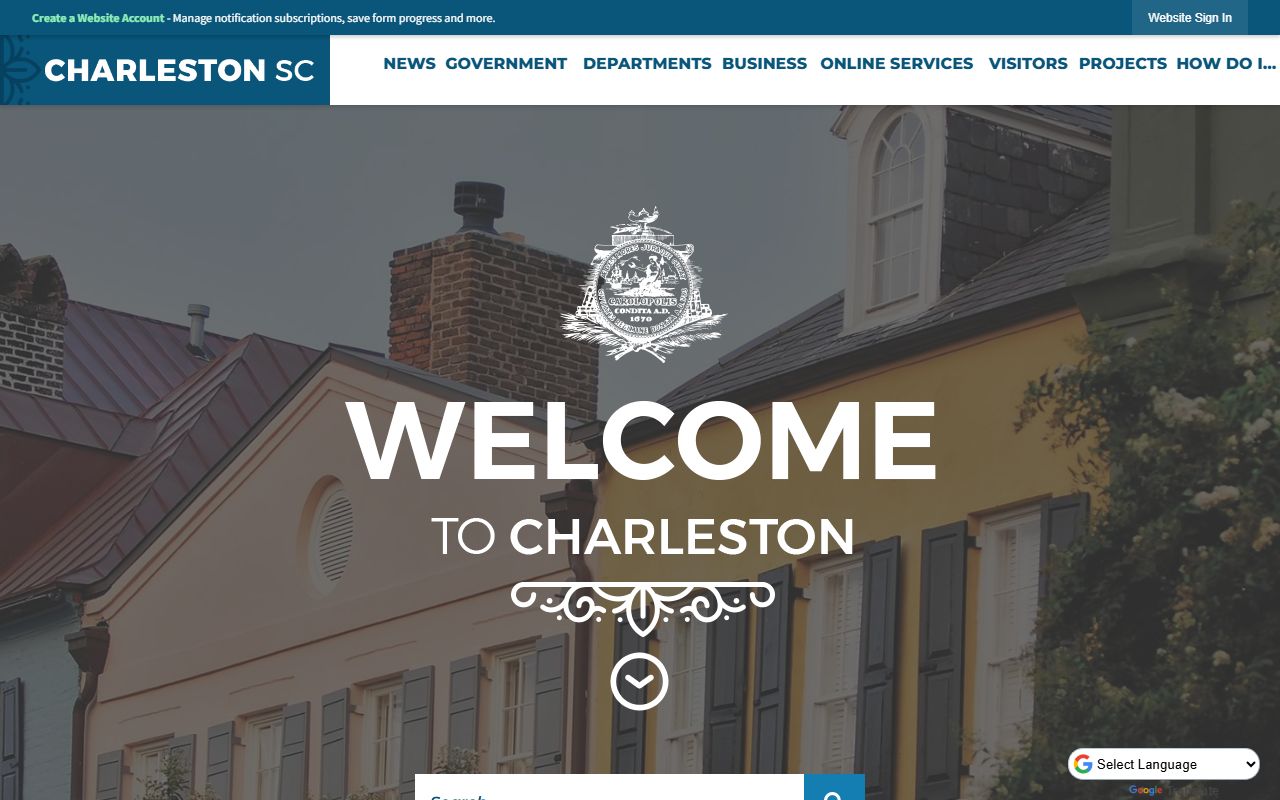
The City of Charleston site at charleston-sc.gov provides access to permit records, code enforcement data, and zoning information for properties within the city limits.
Searching Charleston Property Records Online
The Charleston County real property search system is available at sc-charleston.publicaccessnow.com. You can search by owner name, PIN (Parcel Identification Number), street address, or mailing address. When searching by PIN, enter the number without dashes or spaces. The broader your search terms, the more results you will get. The system supports wildcard searches using an asterisk in advanced search fields.
Records available through the online search system include owner name and mailing address, property address, parcel identification number, legal description, acreage, assessed value, tax district, and links to recorded documents. You can also view property tax bills, payment history, and assessment details without creating an account or paying a fee. The system works best on desktop computers using Google Chrome or Microsoft Edge at a screen resolution of 1024x768 or higher.
The statewide portal at sclandrecords.com also covers Charleston County and lets you search by party name or legal description across counties. This is useful if you are not sure which county a property is in.
Note: The online search provides index data and scanned images of recorded documents. Original documents are typically returned to the property owner after recording, so visiting the office is not usually needed to view document images.
Types of Property Records in Charleston
The Charleston County Register of Deeds maintains a wide range of documents for Charleston properties. Each type of record serves a different purpose. Knowing which record you need helps you search more effectively.
Common property records filed for Charleston properties include warranty deeds and quitclaim deeds showing ownership transfers, mortgage documents and deed of trust instruments, subdivision plats and lot surveys, liens including mechanic's liens and judgment liens, easements and rights-of-way, homeowner association covenants and restrictions, and release and satisfaction documents when loans are paid off. The office also maintains records of foreclosure-related instruments, power of attorney documents related to property transfers, and affidavits of survivorship for jointly held properties.
Plat maps for Charleston subdivisions are especially important in older neighborhoods. Many lots in the historic portions of the city have complex plat histories. The Register of Deeds maintains the plat books, and staff can help you locate the correct plat for a specific parcel.
Note: Under Section 30-5-30 of the South Carolina Code, no deed or other instrument may be recorded until it has been properly acknowledged or proved by affidavit of subscribing witnesses or acknowledgment before a competent officer.
Property Assessment in Charleston
Property assessments for Charleston are handled by the Charleston County Assessor's Office. The assessor sets the value of each parcel, and that value is used to calculate property taxes. South Carolina law under Title 12, Chapter 37 sets the rules for how property is assessed across the state.
Assessment ratios in South Carolina depend on how the property is used. Owner-occupied residences are assessed at 4% of fair market value. Commercial property and second homes are assessed at 6%. Industrial and manufacturing property is assessed by the Department of Revenue at 10.5%, with reductions applied to reach an effective rate of 6.5%. These ratios apply to all Charleston properties under state law. Counties must reassess all property every five years, though a one-year extension is allowed by county ordinance.
Act 388, passed by the South Carolina Legislature in 2006, added the Assessable Transfer of Interest (ATI) rule. Under the ATI rule, if a Charleston property is sold or transferred after December 31, 2006, it is reassessed at full fair market value in the year following the transfer. If a property is not sold or transferred, its taxable value cannot increase by more than 15% between reassessment cycles. This cap protects long-term owners from large tax increases in rising markets. Once a property sells, the cap no longer applies and the new value reflects the sale price.
Recording Requirements for Charleston Properties
All deeds and instruments for Charleston property must be recorded with the Charleston County Register of Deeds to be effective against third parties. South Carolina Title 30 governs recording requirements statewide. Proper recording protects buyers and lenders by putting the world on notice of ownership and encumbrances.
Under Section 30-5-35, all deeds conveying an interest in land executed after July 1, 1976, must include a derivation clause in the property description. The derivation clause identifies where the seller received their title (for example, from whom and in which deed book). The deed must also include the mailing address of the grantee. Missing either element can cause the Register of Deeds to reject the document.
The deed recording fee for Charleston properties follows the statewide schedule set by the South Carolina Department of Revenue. The fee is $1.85 per $500 of value (or fraction thereof) on amounts above $100. The fee has a state portion of $1.30 and a county portion of $0.55. This fee applies to all transfers of real property in Charleston. Exempt transfers include certain family transfers and transactions under specific conditions outlined in SC Revenue Ruling 17-5.
Section 30-5-90 requires the Register of Deeds to record all instruments in the order received and to complete recording within thirty days of when the document is lodged at the office. Most documents submitted to the Charleston County Register of Deeds are processed same day or next day in practice.
Historical Property Records in Charleston
Charleston has some of the oldest property records in the United States. The Register of Deeds holds records dating to 1719. Colonial-era deeds are indexed by surname, which differs from the geographic indexing used for modern records. Researchers working on pre-1900 Charleston properties often need to search both the surname index and the deed books directly.
The Preservation Society of Charleston provides a research guide for historic properties at preservationsociety.org/researching-historic-properties. The guide covers the Register of Deeds, the City Permit Center, and the South Carolina Room at the Charleston County Public Library. The South Carolina Room holds property files, historic maps, city directories, and tax records. It also provides access to Ancestry.com, which includes digitized deed books and other historical property resources for Charleston.
The screenshot below shows the Preservation Society of Charleston research page, which is a starting point for researching historic Charleston properties.
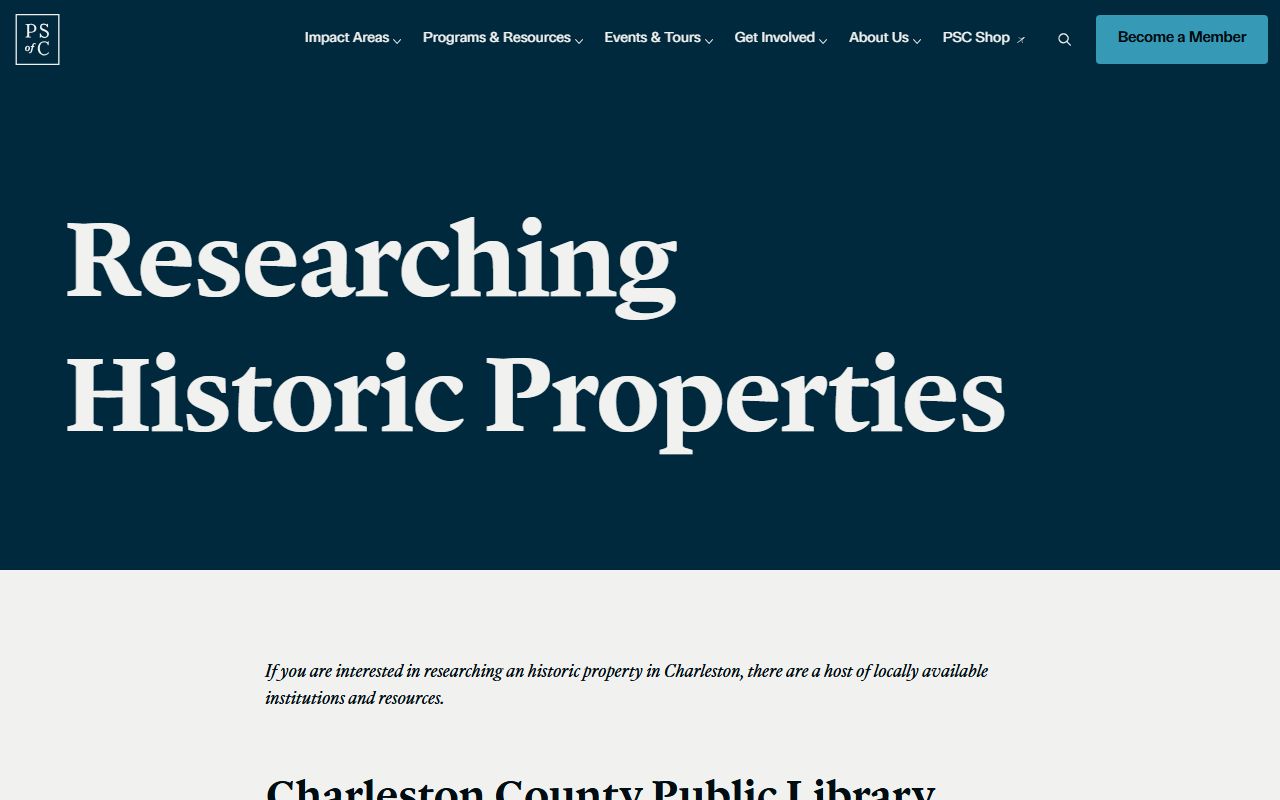
The Preservation Society guide points researchers to the BAR property files at the Permit Center and to the 1929 Sanborn Maps, which show building footprints and materials for most of the historic district. The South Carolina Department of Archives and History at scdah.sc.gov also holds colonial plat books and state land grants that predate county recording systems.
The Charleston County Public Library South Carolina Room is at 68 Calhoun Street. It is open to the public and does not require an appointment for most research visits. Call the library at (843) 805-6930 to confirm current hours before visiting.
South Carolina Land Records Portal
The SC Land Records portal is a statewide tool that provides a searchable index of property records from participating counties across South Carolina. Charleston County is included in the portal. You can access it at sclandrecords.com.
The portal allows you to search by party name or legal description. Results include the names of all parties to a document and a short legal property description. Each result links to the recorded document image in the county's system. This is a free public service and does not require registration. The portal is maintained in cooperation with the South Carolina Register of Deeds Association and covers all 46 recorder districts in the state.
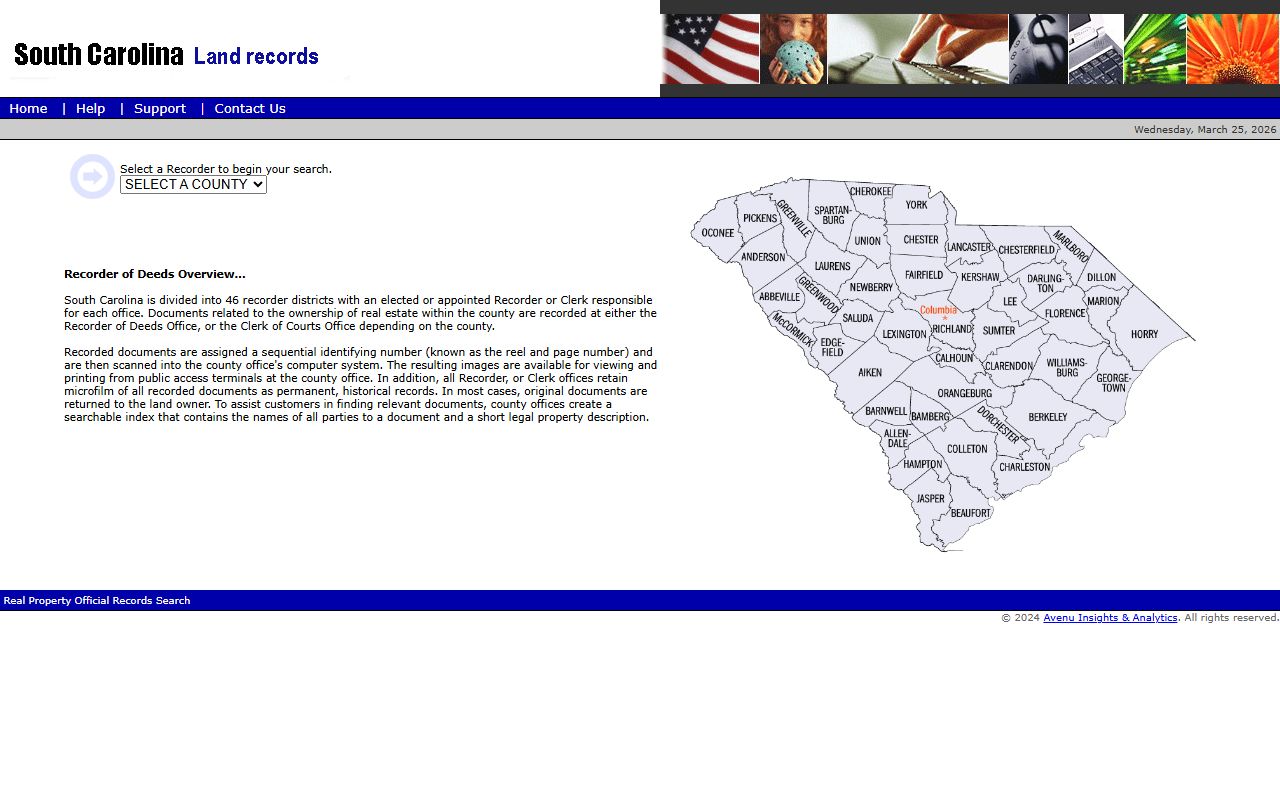
The SC Land Records portal is a good first stop when you are not sure which county office holds the records you need. It is especially useful for properties near county lines or for researchers working across multiple South Carolina counties at once.
Note: The portal provides index data and document images, but certified copies must be obtained directly from the Charleston County Register of Deeds. Contact the office at (843) 958-4800 for copy requests.
Charleston County Property Records
Charleston is located in Charleston County. All deed recording, plat filing, and mortgage recording for Charleston properties runs through Charleston County. For the full county-level overview including recording fees, document requirements, assessor information, and all county resources, visit the Charleston County property records page.
Nearby South Carolina Cities
Residents of nearby cities use their own county recording offices. Select a city to learn about property records in that area.