
Charleston County Real Property Records
Charleston County property records are maintained by the Register of Deeds, one of the most historically significant recording offices in the United States. Records in Charleston County date back to 1719, making this one of the oldest continuously maintained property records systems in the country. The office is located in the O.T. Wallace County Office Building at 101 Meeting Street in downtown Charleston. Anyone needing to search deeds, mortgages, plats, or easements for property in Charleston County can access records online for documents recorded since 1979 or visit the office in person. The Register of Deeds serves the entire county including Charleston, North Charleston, and Mount Pleasant.
Charleston County Quick Facts
Charleston County Register of Deeds
The Charleston County Register of Deeds maintains official land records for the county. The office was historically called the Register Mesne Conveyance, a term still seen on older documents. Today it operates under Section 30-5-10 as one of South Carolina's designated Register of Deeds counties. The office is in Suite 150 of the O.T. Wallace County Office Building and is open Monday through Friday from 8:30 AM to 5:00 PM.
Staff record deeds, mortgages, plats, easements, covenants, liens, and other instruments affecting real property in Charleston County. Documents recorded since 1979 are available through the office's online search system. Documents from 1719 through 1978 are available through in-person research at the office or through the SC Room of the Charleston County Public Library. The office maintains public access terminals in its search room so that researchers can look up records without staff assistance.
The Charleston County Assessor maintains property tax and ownership data that complements the deed records held by the Register of Deeds.
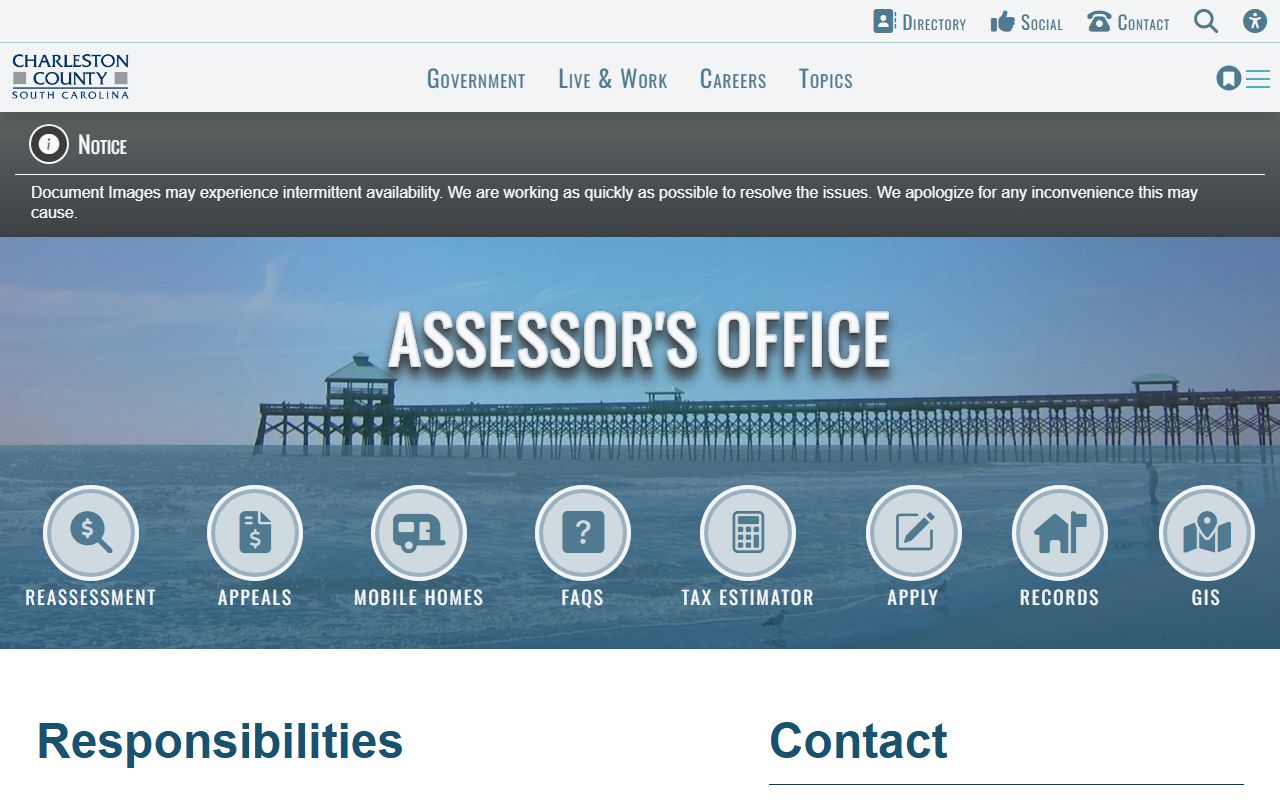
The Assessor's office at charlestoncounty.org provides property tax and ownership data that complements the deed records held by the Register of Deeds.
| Office |
Charleston County Register of Deeds O.T. Wallace County Office Building 101 Meeting Street, Suite 150 Charleston, SC 29401 Phone: (843) 958-4800 Fax: (843) 958-4804 |
|---|---|
| Hours | Monday through Friday, 8:30 AM to 5:00 PM |
| Website | charlestoncounty.org/departments/register-of-deeds |
| Recording Fee | $15.00 first page; $5.00 each additional page |
| Deed Recording Fee | $1.85 per $500 of property value |
| Online Records | Documents recorded since 1979 |
Note: The Register of Deeds office is located at Suite 150 for recording services. Deeds, mortgages, plats, easements, and covenants are accessible at Room 200 of the same building for public research.
Online Property Records Search
Charleston County provides a Real Property Record Search system at sc-charleston.publicaccessnow.com. This system lets you look up property records by owner name, PIN (Parcel Identification Number), street address, mailing address, or a combination of these. The search covers current ownership and assessment data along with links to recorded documents.
The Charleston County Real Property Record Search at sc-charleston.publicaccessnow.com lets you look up properties by owner name, PIN, or address and view assessment data and recorded documents.
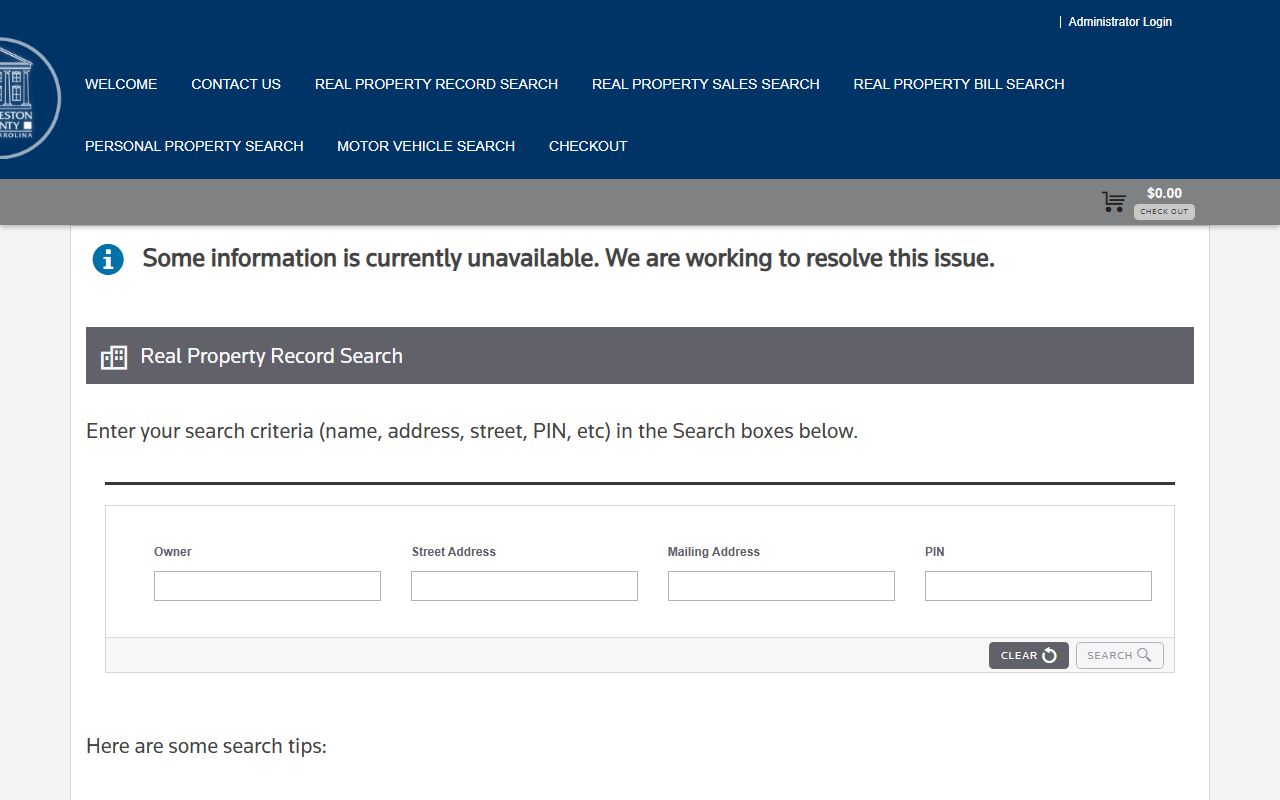
The online system returns the owner's name, property address, mailing address, PIN, legal description, acreage, assessed value, and tax district. You can also search property sales history and tax bill information from the same portal. When searching by PIN, enter the number without dashes or spaces. A wildcard asterisk (*) is supported in the advanced search fields for partial name or address searches. The system works best on a desktop computer using Google Chrome or Microsoft Edge at a screen resolution of 1024x768 or higher.
For documents recorded before 1979, you must visit the Register of Deeds office in person or contact the South Carolina Room at the Charleston County Public Library. The library's SC Room at 61 Calhoun Street provides access to published deed abstracts and historical property research resources.
Property Documents Recorded in Charleston County
The Register of Deeds office records every type of instrument affecting real property in Charleston County. Warranty deeds, limited warranty deeds, and quitclaim deeds transfer ownership between parties. Mortgages and deeds of trust are recorded when real property secures a loan. Mortgage satisfactions cancel the lien once a loan is paid. Plats show the boundaries of parcels and are recorded when land is surveyed or subdivided. Easements, restrictive covenants, and homeowners association documents are also part of the public record.
Under Section 30-5-35, all deeds and mortgages executed after July 1, 1976 must include a derivation clause. This clause names the instrument by which the grantor acquired the property, creating a link in the chain of title. The grantee's mailing address must also appear on the deed. These requirements help ensure that each document ties back to its predecessor in the ownership history.
The Preservation Society of Charleston offers research guidance for historic properties at preservationsociety.org. The society notes that the O.T. Wallace County Office Building at 101 Meeting Street, Room 200 provides access to deeds, mortgages, plats, easements, and covenants. The City of Charleston Permit Center at Gaillard Center, 2 George Street, holds Board of Architectural Review property files, survey cards, and 1929 Sanborn Maps.
Recording Requirements
All documents submitted for recording in Charleston County must meet the standards set by state law and the Register of Deeds office. Documents must be original with original signatures. They must be legible and suitable for digital scanning. The first page must have a three-inch top margin so that the recording stamp and index data can be applied. All other margins must be at least one inch. Text must be printed or typed in black ink at a readable size.
Under Section 30-5-30, a deed cannot be recorded until it has been properly acknowledged. The grantor must sign in front of a notary public, and the notary's acknowledgment certificate must appear on the face of the document. Alternatively, a deed can be proved by an affidavit of a subscribing witness before an authorized officer. Both methods satisfy the prerequisites for recording in Charleston County.
The deed recording fee is $1.85 per $500 of property value. The South Carolina Department of Revenue provides complete fee guidance at dor.sc.gov. The state's portion of the fee is $1.30 per $500, and the county retains $0.55 per $500. The Register of Deeds collects the full amount and remits the state portion monthly.
Note: Section 30-5-90 requires the Register of Deeds to record all lodged instruments within thirty days, in the order in which they are received.
Historical Property Records
Charleston County's property records are among the oldest in the United States. The Register of Deeds holds official records from 1719 to the present. This span covers more than three centuries of land transactions in one of America's oldest cities. No other county in South Carolina has a continuous recording history that goes back this far.
The 18th and 19th-century deeds in the Register of Deeds archive are indexed by surname. The 20th and 21st-century deeds are indexed by geographic location. This difference in indexing methods matters when you plan a historical title search. Published abstracts of all deeds from 1719 through 1788 are available at the South Carolina Room of the Charleston County Public Library. The SC Room is located at 61 Calhoun Street on the second floor. Contact the SC Room at (843) 805-6959 with research questions about early Charleston County property records. Visit ccpl.org/south-carolina-room for more information.
The South Carolina Department of Archives and History at scdah.sc.gov also holds colonial-era land grants and plats. The Surveyor General's Colonial Plat Books from 1731 to 1775 and State Plat Books from 1784 to 1868 document the earliest land grants in the Charleston area. These records predate even the Register of Deeds system and are essential for tracing the origins of land titles in the Lowcountry region.
Charleston County Property Assessment
The Charleston County Assessor's office appraises all real property in the county for tax purposes. Visit charlestoncounty.org/departments/assessor to search property ownership and assessed value records online. The Assessor maintains a comprehensive database that covers ownership history, property characteristics, and current assessment information.
South Carolina law under Title 12, Chapter 37 sets the assessment ratios that apply to all property in Charleston County. An owner-occupied primary residence is assessed at 4% of fair market value. Other real property, including investment properties and second homes, is assessed at 6%. Agricultural land carries the 4% ratio. Charleston County is required to conduct a countywide reassessment every five years. Between reassessments, the taxable value of a property that does not change hands cannot increase by more than 15%, under the cap established by Act 388. When a property sells or is otherwise transferred, an Assessable Transfer of Interest (ATI) triggers a reassessment at full fair market value for the following tax year.
Note: Buyers of property in Charleston County should confirm the assessment status with the Assessor's office after closing, since the ATI reassessment can significantly change the tax bill in the year following a purchase.
Cities in Charleston County
Charleston County covers a large area along the South Carolina coast and includes several major cities. All property recording for land in Charleston County is handled by the Register of Deeds at 101 Meeting Street in downtown Charleston.
Charleston is the county seat and the largest city. North Charleston and Mount Pleasant are also major communities in the county, and all property records for these cities are filed with the Charleston County Register of Deeds.
Nearby Counties
Charleston County borders several other South Carolina counties. Real property must be recorded in the county where the land is located. If you are unsure which county holds the records you need, check the physical address of the property.