
Anderson County Deed Records and Property Search
Anderson County property records are maintained by the Register of Deeds office at 401 E. River Street in Anderson. The office records deeds, mortgages, plats, and other land documents, then indexes them in a Public Access System that allows searches by TMS number, owner name, or street name. Anderson County is one of the larger counties in the Upstate region of South Carolina, with a significant amount of real estate activity recorded each year. The Register of Deeds can be reached at (864) 260-4057.
Anderson County Quick Facts
Anderson County Register of Deeds
The Anderson County Register of Deeds is designated by Section 30-5-10 of the South Carolina Code as the official recording office for real property documents in the county. The office records, indexes, and preserves legal instruments affecting real and personal property. All documents are scanned upon receipt and indexed for public access through the county's Public Access System. Staff at the Register of Deeds can provide copies of plats and deeds on request.
The screenshot below is from the official Anderson County Register of Deeds page, which provides information about the office's services, the Public Access System, and recording procedures.
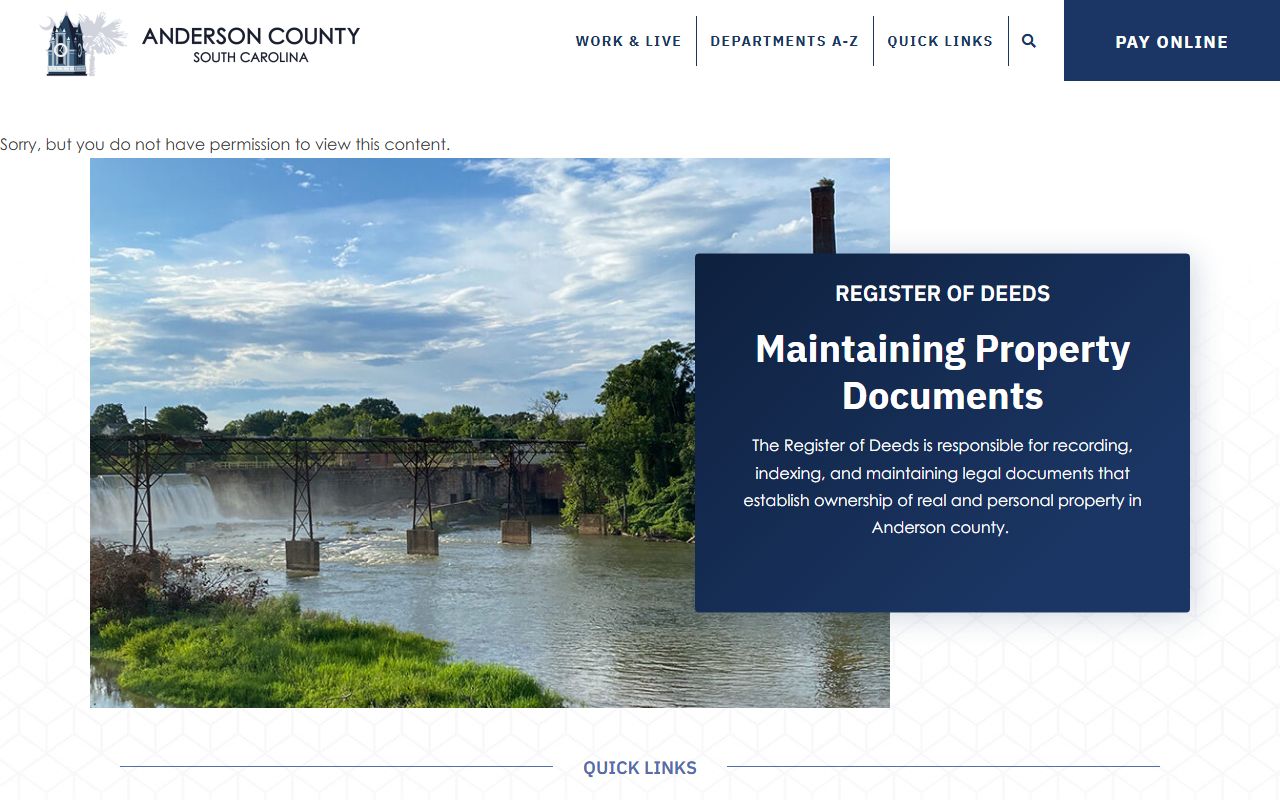
The Register of Deeds page on the county website is the best starting point for online access to Anderson County property records and document search tools.
| Office |
Anderson County Register of Deeds 401 E. River Street Anderson, SC 29624 Phone: (864) 260-4057 |
|---|---|
| Website | andersoncountysc.org |
| Hours | Monday through Friday, 8:30 AM to 5:00 PM |
Anderson County Assessor Property Records
The Anderson County Assessor's Office maintains a database of physical characteristics for all properties in the county. The office uses this data to classify and appraise real property for tax purposes. The Assessor provides a Public Access System for searching parcel information by TMS (Tax Map System) number, owner name, or street name. This system is particularly useful for identifying a property's parcel number before searching for recorded documents at the Register of Deeds.
The image below is from the Anderson County Assessor's page, which describes assessment procedures, the ATI process, and how to access the public search system.
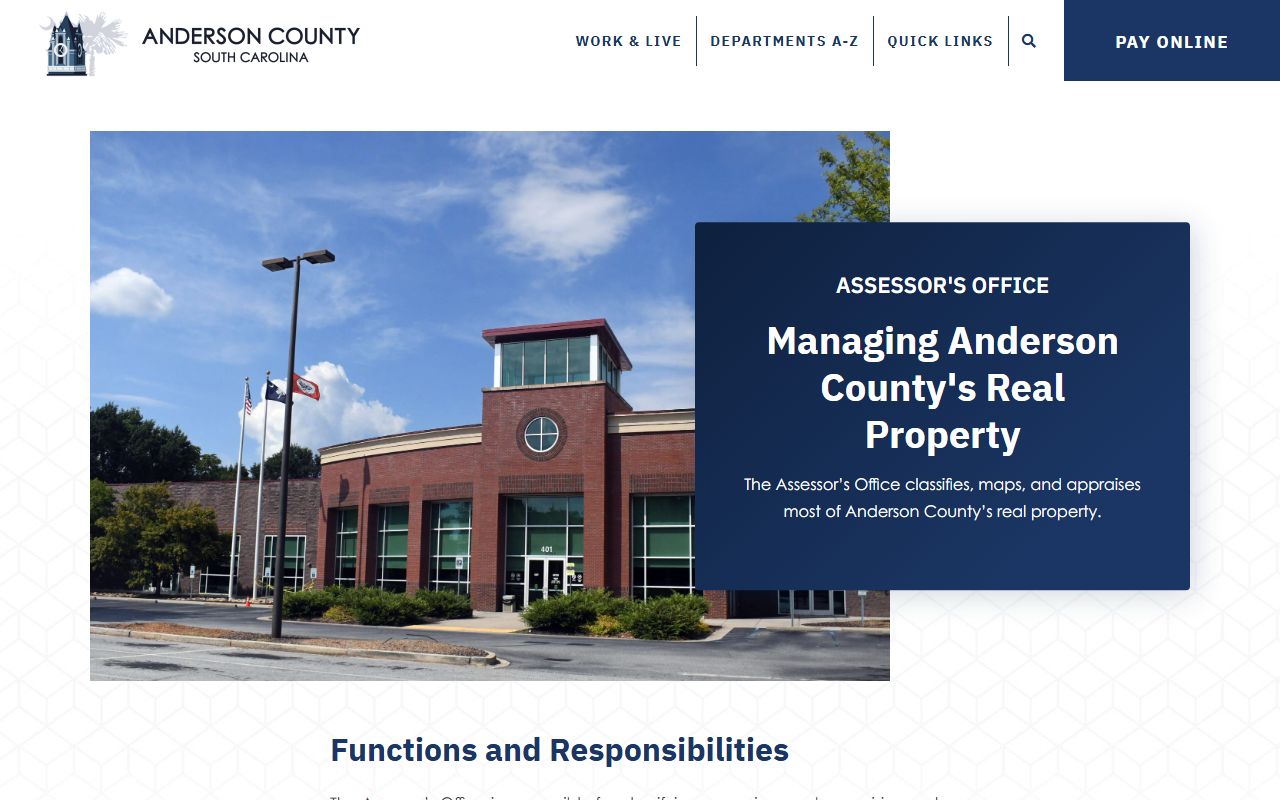
The Assessor's Office page at andersoncountysc.org explains the assessment ratios, reassessment cycle, and how to appeal a property valuation in Anderson County.
Anderson County mails a Notice of Classification, Appraisal and Assessment of Real Estate to property owners when the market value and taxable value increases by more than $1,000 as a result of an Assessable Transfer of Interest (ATI). The notice shows the ATI value and the reason for the change, as required by South Carolina law.
Searching Anderson County Property Records
The Register of Deeds Public Access System allows you to search Anderson County property records by TMS parcel number, owner name, or street name. Use the parcel number from the Assessor's system to pull up recorded instruments at the Register of Deeds. The system displays document type, recording date, grantor, grantee, and a link to scanned images.
You can also search through the statewide SC Land Records portal. The portal covers many South Carolina counties and lets you search by party name and short legal description. This is a good cross-reference tool if you do not find what you need through the county's own system.
For in-person visits, the Register of Deeds is at 401 E. River Street in Anderson. Staff can help you search the index and request copies. Bring a parcel number, prior deed book and page reference, or the names of the parties involved in the transaction you are researching.
Note: GIS mapping is available through the county website and lets you view property boundaries and parcel data alongside ownership information.
Property Documents Recorded in Anderson County
Anderson County property records include a full range of real estate instruments. Warranty deeds and special warranty deeds transfer fee simple title. Quitclaim deeds convey whatever interest the grantor holds without making warranties. Mortgages and deeds of trust secure real property as collateral for loans. Plats are survey drawings that show parcel boundaries, dimensions, and lot numbers for subdivisions.
Additional documents recorded at the Anderson County Register of Deeds include:
- Assignments and releases of mortgages
- Easements and right-of-way agreements
- Powers of attorney for real estate transactions
- Mechanic's liens and lis pendens notices
- UCC financing statements secured by real property
Each instrument is indexed under the grantor and grantee names and assigned a book and page number in the county's recording system. This index is the primary search tool for locating specific documents.
Recording Requirements and Fees in Anderson County
Documents submitted for recording must comply with South Carolina statutes. Section 30-5-30 requires that each instrument be acknowledged before a notary public or proved by affidavit of a subscribing witness before the Register of Deeds can accept it for recording. The document must bear original signatures. South Carolina also requires two witnesses on real estate instruments.
Under Section 30-5-35, every deed and mortgage must include a derivation clause. The derivation clause states where the grantor acquired title, typically referencing a prior deed by book, page, and recording date. The grantee's or mortgagee's mailing address must appear on the face of the document as well.
Recording fees are $15.00 for the first page and $5.00 for each additional page. The state deed recording fee from the South Carolina Department of Revenue is $1.85 per $500 of the property's stated value. This fee applies to deeds that transfer ownership. The Register of Deeds collects and remits the state portion monthly through the MyDORWAY electronic filing system. Under Section 30-5-90, the Register of Deeds must record documents within 30 days of receiving them.
Anderson County Property Assessment and ATI
The Anderson County Assessor conducts a countywide reassessment every five years, as required by Title 12, Chapter 37 of the South Carolina Code. During the reassessment, every parcel in the county is reappraised to its current fair market value as of December 31st of the year before implementation. The reassessment ensures that property taxes are distributed equitably across all property owners.
South Carolina's Act 388 of 2006 established two key protections. First, a property's taxable value cannot increase by more than 15% between reassessment cycles unless an Assessable Transfer of Interest (ATI) occurs. Second, when a property is sold or transferred in a qualifying transaction after December 31, 2006, it is reassessed at full market value for the following tax year. This ATI valuation overrides the 15% cap for the year following the transfer.
Assessment ratios set by state law are 4% for owner-occupied residential homes, 4% for qualifying agricultural land, and 6% for commercial, rental, and other non-primary-residence property. The Assessor's Office is the first stop for questions about a property's current assessed value or the basis for any change in classification.
Historical Property Records in Anderson County
Anderson County was formed from the Pendleton District in 1826. Property records for land now in Anderson County that predate the county's formation may be found in the Pendleton District archives. The Register of Deeds maintains records from the county's formation forward. Older deed books and plat records may be available in microfilm or original form at the courthouse or through the state archives.
The South Carolina Department of Archives and History holds historical property records for all counties, including original deed books, plat volumes, and land grant records for the area that became Anderson County. These records are available for research in Columbia or through online finding aids. The archives also maintain the Surveyor General's colonial and state plat books, which document the original land grants in the Upstate region.
Note: For title research going back more than 40 years, consulting the Register of Deeds in person and reviewing original deed books may be more reliable than relying solely on the digital index.
South Carolina Land Records and Anderson County
The SC Land Records portal provides online access to indexed property records from counties across South Carolina, including Anderson County. The portal lets you search by party name and returns results showing the document type, recording date, and a short legal description. This statewide tool complements the county's own Public Access System.
South Carolina's recording system assigns each document a sequential reel and page number that serves as its permanent identifier in the county's index. Original documents are typically returned to the property owner after recording. The county retains a scanned image and microfilm copy as the permanent official record. These images are the source for certified copies available through the Register of Deeds.
Cities in Anderson County
Anderson County includes cities and communities across the Upstate region. All property records for land within Anderson County, including the city of Anderson, are filed with the Register of Deeds at 401 E. River Street.
The city of Anderson is the county seat and the largest city in Anderson County. All deed recordings for properties within the city are maintained at the Anderson County Register of Deeds.
Nearby Counties
Anderson County borders several counties in the Upstate and western South Carolina regions. Properties near a county line may have records in a neighboring county's recording office.