
Calhoun County Deed and Property Records
Calhoun County property records are kept by the Clerk of Court in St. Matthews, South Carolina. The office records all deeds, mortgages, plats, and liens filed in the county. Calhoun County was formed in 1908 from parts of Lexington and Orangeburg counties, and deed books have been maintained since that time. Anyone who needs to research land ownership, verify a title, or find historical conveyances can access Calhoun County property records through the Clerk of Court or through state online tools. The county seat is St. Matthews, and the Clerk's office serves the entire county.
Calhoun County Quick Facts
Calhoun County Clerk of Court
The Clerk of Court in St. Matthews handles all real property recording for Calhoun County. Under Section 30-5-10 of the South Carolina Code, counties not listed as having a separate Register of Deeds perform recording duties through the Clerk of Court. Calhoun is one of those counties. The Clerk records deeds, mortgages, mechanic's liens, plats, and any other instrument affecting title to land located within the county.
Every document brought in for recording must meet the standards set by state law before the Clerk will accept it. The document must be original, it must carry original signatures, and it must be legible enough for digital scanning. The first page must have a three-inch clear margin at the top so that the recording stamp and indexing data can be added. Once accepted, the document is assigned a book and page number, scanned into the county system, and indexed by the names of the parties. The recording fee is $15 for the first page and $5 for each page after that.
| Office |
Calhoun County Clerk of Court P.O. Box 6 St. Matthews, SC 29135 Phone: (803) 874-3524 |
|---|---|
| Website | calhouncounty.sc.gov |
| Recording Fee | $15.00 first page; $5.00 each additional page |
| Deed Recording Fee | $1.85 per $500 of property value |
The SC Department of Revenue oversees the deed recording fee statewide. Visit dor.sc.gov for the full fee schedule and guidance on how the fee is calculated for different types of transfers.
Searching Calhoun County Property Records
There are two main ways to search Calhoun County property records. You can visit the Clerk of Court in person at St. Matthews, or you can use the SC Land Records statewide portal online. Both methods give you access to recorded documents. In-person access lets you review original index books and request copies directly from staff.
The SC Land Records portal at sclandrecords.com is a statewide tool that covers many South Carolina counties. The portal provides a searchable index of recorded documents including the names of parties and a short legal description of the property. This lets you find a deed or mortgage by grantor or grantee name without traveling to the courthouse. Once you locate a document in the index, you can note the book and page number and request a copy from the Calhoun County Clerk of Court.
When searching, have as much information as possible ready. A property owner's full name helps narrow results. A parcel number or street address can also help you identify the right records. For older transactions recorded before Calhoun County was formed in 1908, records may be held by Lexington or Orangeburg County since those were the parent counties.
Note: Calhoun County was formed from Lexington and Orangeburg counties in 1908, so property conveyances before that date will appear in one of those two parent county archives.
Types of Property Records in Calhoun County
The Clerk of Court in Calhoun County maintains a wide range of real property instruments. Deeds are the most common. A deed transfers ownership of land from one party to another. Other recorded instruments include mortgage documents, which create a security interest in real property as collateral for a loan. Releases or satisfactions cancel mortgages once a loan is paid off.
Plats are another important type of record. A plat is a survey map that shows the boundaries of a parcel. Plats recorded with the Clerk of Court become part of the official record and are referenced in later deeds. Easements, which grant rights to use a portion of land, are also recorded here. Mechanic's liens, filed when a contractor or supplier has not been paid for work on real property, are recorded and can affect title.
A full title search in Calhoun County typically reviews all these document types across a chain of ownership. Under Section 30-5-35, deeds executed after July 1, 1976 must include a derivation clause that identifies how the grantor acquired the property. This clause links each deed to the prior one and supports a proper chain of title.
- Warranty deeds and quitclaim deeds
- Mortgages and deeds of trust
- Mortgage releases and satisfactions
- Subdivision plats and boundary surveys
- Easements and rights of way
- Mechanic's liens
- Lis pendens notices
Recording Requirements for Calhoun County
South Carolina law sets clear requirements for any document to be recorded in Calhoun County. Under Section 30-5-30, a deed must be acknowledged or proved before an officer authorized to administer oaths. This typically means the grantor signs the deed in front of a notary public. The notary's acknowledgment certificate must appear on the document. Without proper acknowledgment, the Clerk of Court cannot accept the document for recording.
Formatting rules also apply. The document must be on paper that is at least 8.5 by 11 inches. Text must be printed clearly in black ink at a size large enough to be read and scanned. The three-inch top margin on the first page is required. The margins on all other edges must be at least one inch. Any exhibit or attachment must also meet these standards.
The deed recording fee under SC Revenue Ruling #17-5 is calculated based on the property value. The fee is $1.85 for every $500 of value, starting at the $100 threshold. The county collects this fee at the time of recording and remits the state's portion to the SC Department of Revenue by the 20th of the following month.
Note: Section 30-5-90 requires the Clerk of Court to record all submitted instruments within thirty days of lodgment, in the order they were received.
Property Assessment in Calhoun County
The Calhoun County Tax Assessor values all real property in the county for tax purposes. Assessment ratios in South Carolina are set by state law under Title 12, Chapter 37. An owner-occupied home is assessed at 4% of fair market value. Other real property, including commercial property and second homes, is assessed at 6%. Agricultural land also carries a 4% ratio.
South Carolina law requires each county to conduct a countywide reassessment every five years. Under Act 388, the increase in taxable value for property that does not change hands is capped at 15% between reassessments. When a property is sold or transferred after December 31, 2006, an Assessable Transfer of Interest (ATI) occurs. At that point the property is reassessed at full fair market value for the next tax year. This reset removes the cap for newly transferred parcels. The Calhoun County Assessor can answer questions about assessed values and appeal procedures.
The SC Association of Counties at scac.org provides general guidance on how county government offices including assessors operate across all 46 South Carolina counties.
SC Land Records Portal
The SC Land Records portal is a free statewide resource for searching recorded property documents. The screenshot below shows the portal interface available at sclandrecords.com.
The SC Land Records statewide portal provides a free searchable index of recorded property instruments for Calhoun County and all 46 South Carolina recorder districts.
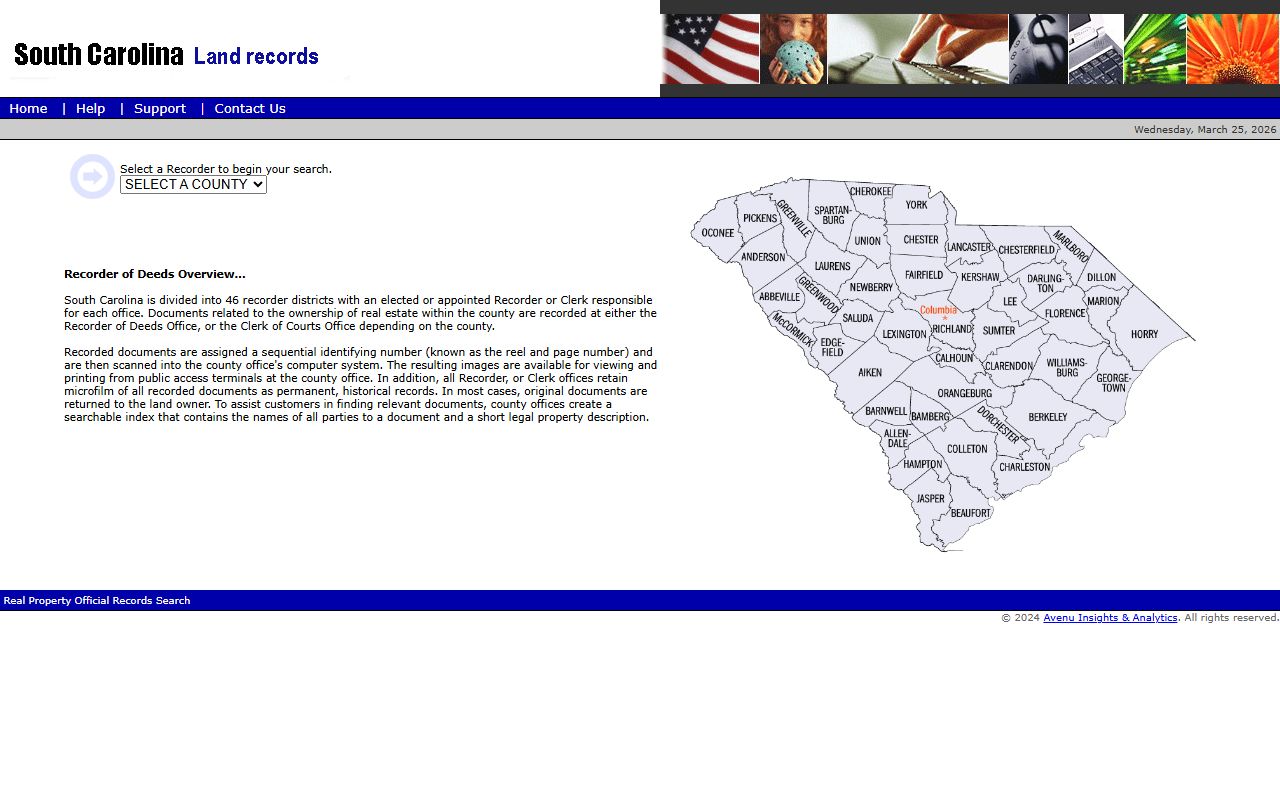
The portal indexes document names and legal descriptions from county recording offices across South Carolina, giving researchers a single starting point for title searches.
South Carolina's 46 recorder districts each maintain their own document images. The portal links you to those images once you identify a document through the index. For Calhoun County, recorded documents are scanned and stored at the Clerk of Court office in St. Matthews. County offices also retain microfilm copies as permanent backup records. Original documents are typically returned to the landowner after recording is complete. The statewide index lets you search by grantor or grantee name and review a short legal description before you pull the full document.
Historical Property Records for Calhoun County
The South Carolina Department of Archives and History at scdah.sc.gov holds historical land records that extend well beyond what individual county offices maintain. The department preserves the Surveyor General's records, including Colonial Plat Books from 1731 to 1775 and State Plat Books from 1784 to 1868. These records document the original land grants issued under the Lords Proprietors and later by the State of South Carolina.
The South Carolina Department of Archives and History maintains colonial plat books and state land grants that document early ownership in the area that became Calhoun County in 1908.

Because Calhoun County was created from Lexington and Orangeburg in 1908, pre-formation land grants and early deed books are held by those parent counties or by the state archives. Researchers tracing land ownership back into the 1800s should check both Orangeburg County and Lexington County records. The FamilySearch database also indexes historical land records for Calhoun County and can point researchers to the correct source volume.
Note: The SC Department of Archives holds the official state land grant records and colonial plat books, which are the starting point for many historical title chains in South Carolina.
Deed Recording Fee Information
The SC Department of Revenue publishes detailed guidance on the deed recording fee, shown below from the official SCDOR website.
The South Carolina Department of Revenue publishes the official deed recording fee schedule that applies to all property transfers recorded in Calhoun County.
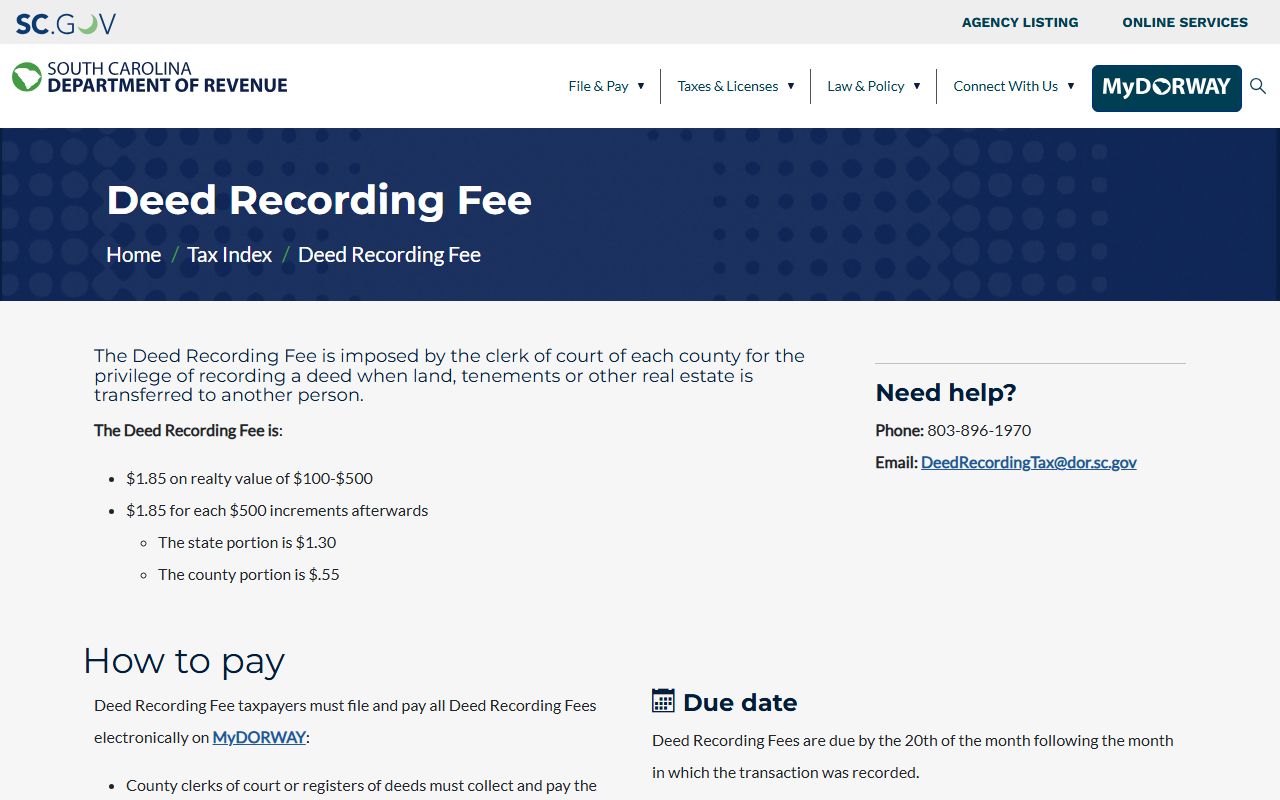
The fee applies to all real estate transfers recorded in Calhoun County and is split between the state and the county portions.
The deed recording fee is $1.85 per $500 of property value. Of this amount, $1.30 goes to the state and $0.55 stays with the county. The Clerk of Court collects the full fee at the time of recording. Certain transfers are exempt, including gifts to family members and transfers between government entities. SC Revenue Ruling #17-5 addresses the full range of transactions and exemptions. The ruling covers gifts, family transfers, LLC transactions, foreclosure deeds, 1031 exchange deeds, and many other situations. The ruling is available at the SC Department of Revenue website.
Nearby Counties
Calhoun County borders several South Carolina counties. If you are not sure which county holds the records you need, check the property address. Recording is done in the county where the land is located.