
McCormick County Deeds and Property Records
McCormick County property records are kept by the Clerk of Court in the town of McCormick, South Carolina. The Clerk records and preserves all deeds, mortgages, liens, plats, and other instruments affecting real property title in the county. McCormick County sits in the western part of the state along the Savannah River, bordered by Greenwood, Edgefield, Abbeville, and Saluda counties. The county is among the smallest in South Carolina by population, yet its Clerk of Court maintains a complete record of every real estate transaction filed within its boundaries.
McCormick County Quick Facts
McCormick County Clerk of Court
The McCormick County Clerk of Court serves as the official recording officer under S.C. Code Ann. § 30-5-10. This statute designates the Clerk of Court as the recording authority in counties that do not maintain a separate Register of Deeds. McCormick County falls under this provision. All instruments affecting real property title in McCormick County must be filed with this office to be valid against subsequent purchasers and creditors.
The Clerk of Court office is located at the McCormick County Courthouse in McCormick. Staff can assist in locating documents by name or reference number. They can prepare copies for a per-page fee. The office does not conduct full title searches or provide legal advice on document preparation. For professional title work, contact a licensed South Carolina attorney. The official McCormick County website is mccormickcounty.org, though users should note the site has experienced DNS issues; the Clerk of Court can be reached by phone for records inquiries.
| Office |
McCormick County Clerk of Court P.O. Box 333 McCormick, SC 29835 Phone: (864) 465-2195 |
|---|---|
| Hours | Monday through Friday, 8:30 AM to 5:00 PM |
How to Search McCormick County Property Records
The primary method for searching McCormick County property records is in person at the Clerk of Court. The office maintains a grantor-grantee index that lists every recorded instrument by the names of the parties. You search the grantee index to trace who received property and the grantor index to follow who conveyed it. Together these indexes allow you to build a complete chain of title from the current owner back through prior owners.
The statewide SC Land Records portal at sclandrecords.com is a free online resource that provides name-indexed searches for recorded documents in participating South Carolina counties. Enter the name of a property owner or party to the transaction and the system returns matching document entries with brief property descriptions and document reference numbers. Use those numbers to request full copies from the McCormick County Clerk of Court.
When visiting the courthouse in person, bring the property address, parcel number, or the names of known prior owners. The grantor-grantee index goes back many decades and is the backbone of any title search in McCormick County. For older deed books, some records may be on microfilm. Staff can direct you to the appropriate resources once you describe what you are looking for.
Note: The SC Land Records index is a finding aid, not a substitute for a certified title search conducted by a professional examining the original instruments in the deed books.
Types of Property Documents Recorded in McCormick County
The McCormick County Clerk of Court records all instruments that affect the title, ownership, or encumbrance of real property situated in the county. Warranty deeds are the most common instrument. They transfer fee simple title with covenants from the grantor guaranteeing clear title. Quitclaim deeds transfer whatever interest the grantor holds without warranty and are often used between family members or to clear title defects. Trustee deeds convey property to or from a trust arrangement.
Mortgages and deeds of trust create liens on real property as security for loans. When a loan is repaid, the lender files a satisfaction or release, which removes the lien from the public record. Mechanic's liens protect contractors and material suppliers who improve real property in McCormick County. Judgment liens attach automatically to real property when a court enters a money judgment against a property owner in the county. Federal and state tax liens filed by the IRS or SCDOR also appear in the recording records and must be cleared before a sale can close.
Plats record the surveyed boundaries and dimensions of parcels and subdivisions. They are essential for understanding the physical layout of any tract of land in McCormick County. Under S.C. Code Ann. § 30-5-90, the Clerk must record all writings concerning land titles in the order received.
Recording Requirements and Fees
Before the McCormick County Clerk of Court will accept a document for recording, it must meet the requirements of S.C. Code Ann. § 30-5-30. The document must be acknowledged before a notary public or other authorized officer. The notary's certificate must show the date of acknowledgment, the state and county where it was taken, and the notary's signature and seal.
South Carolina Code § 30-5-35 requires that deeds and mortgages executed after July 1, 1976, contain a derivation clause identifying the prior deed or instrument through which the grantor acquired title. The mailing address of the grantee or mortgagee must also appear in the document. Instruments that fail to meet these standards will be returned for correction. The recording fee is $15 for the first page and an additional fee for each page after that. Deeds also carry the separate deed recording fee of $1.85 per $500 of realty value collected for the South Carolina Department of Revenue.
The SC Department of Revenue website explains the deed recording fee structure that applies in McCormick County.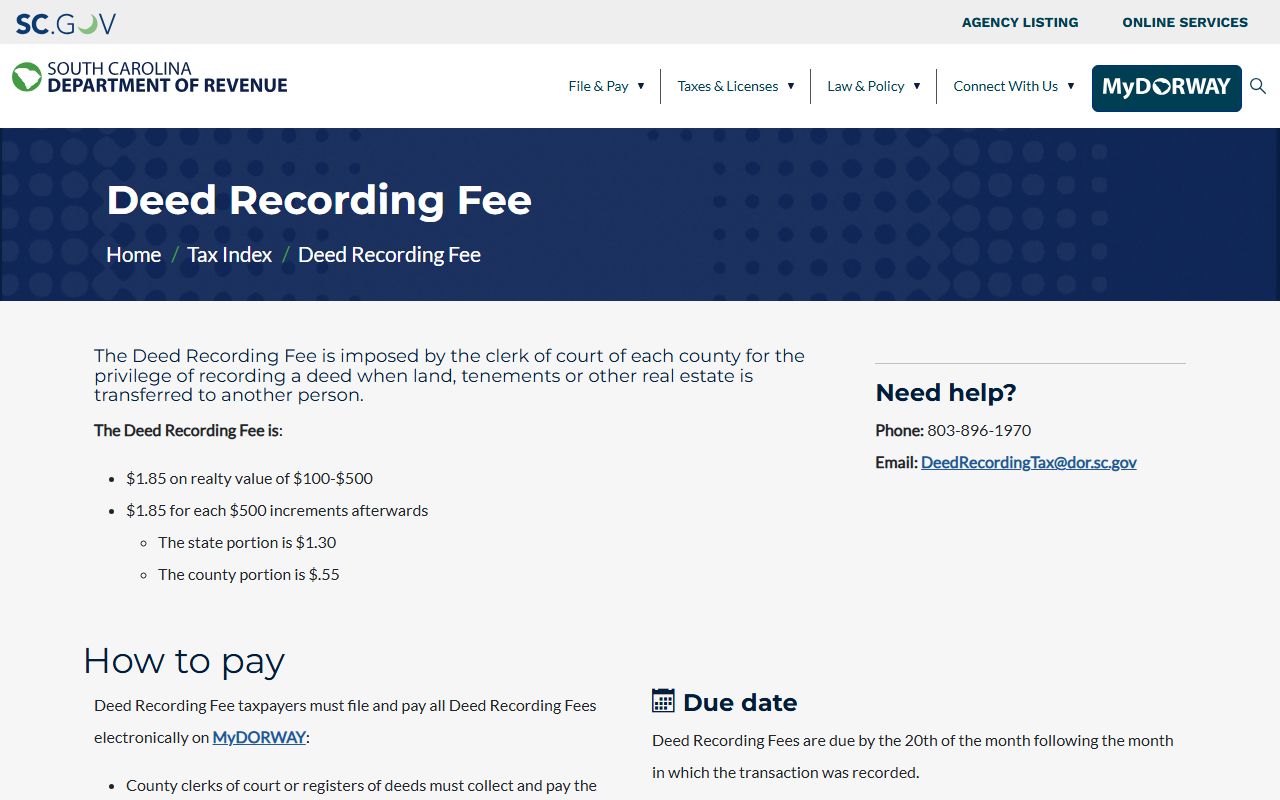
The $1.85 per $500 deed recording fee applies statewide, including all real estate transfers in McCormick County.
McCormick County Property Assessment
The McCormick County Assessor values real property for tax purposes under the framework set by S.C. Code Ann. § 12-37. South Carolina requires a countywide reassessment every five years. The county may extend this cycle by one year through ordinance. Between reassessments, Act 388 caps any increase in taxable value at 15% for properties that have not changed hands. When a property is sold or transferred after December 31, 2006, and the transfer qualifies as an Assessable Transfer of Interest (ATI), the Assessor revalues the property at full fair market value for the next tax year.
Owner-occupied residences in McCormick County are assessed at 4% of fair market value. Agricultural property that qualifies under state law is also assessed at 4%. All other real property, including commercial and investment parcels, is assessed at 6%. These ratios are applied to the fair market value established by the Assessor to arrive at the assessed value used for tax calculation. McCormick County property owners can appeal their assessments under the procedures set by state law.
Historical Property Records in McCormick County
McCormick County was created in 1916 from parts of Abbeville, Edgefield, and Greenwood counties, making it one of South Carolina's youngest counties. Property records at the Clerk of Court begin with the county's formation. For earlier records covering land now in McCormick County, researchers must look to the records of the predecessor counties. Abbeville County Clerk of Court, Edgefield County, and Greenwood County each hold instruments from the periods when their jurisdictions included what is now McCormick County territory.
The South Carolina Department of Archives and History in Columbia holds the state's oldest land records, including colonial and state land grants and the Surveyor General's plat books. These records extend back to the Lords Proprietors period in the late 1600s. Visit scdah.sc.gov to learn how to access these materials. The SCDAH is also a good resource for McCormick County researchers interested in the history of land along the Savannah River, including the area now covered by Lake Thurmond.
The South Carolina Department of Archives and History is the primary repository for historical land records relevant to McCormick County.
Researchers tracing property in McCormick County may need to consult predecessor county records held at the SCDAH.
Statewide Property Resources
Researchers working with McCormick County property records have access to several statewide resources. The SC Land Records portal provides a free online index of recorded documents searchable by party name. The South Carolina Association of Counties at scac.org offers guidance on how county governments manage property records. The SC Judicial Branch at sccourts.org maintains court records for foreclosure proceedings, probate matters, and civil litigation that may affect title to McCormick County property.
The SC Land Records portal at sclandrecords.com provides basic parcel and ownership information for McCormick County. For a review of the full statutory framework governing property records in South Carolina, see Title 12 and Title 30 of the South Carolina Code at the SC Legislature's website.
The South Carolina Association of Counties provides resources on property records administration across all 46 counties.
The SC Association of Counties connects county offices and promotes consistent property records practices statewide.
Note: When searching McCormick County records, always verify document completeness at the Clerk of Court. Online indexes are starting points, not final answers.
Nearby Counties
McCormick County borders Greenwood, Edgefield, Abbeville, and Saluda counties. Each maintains its own property recording office. If your property research involves parcels in more than one county, you will need to search each county's records separately.