
Dillon County Property Records Search
Dillon County property records are maintained by the Clerk of Court in Dillon, South Carolina. The Clerk records and preserves all real estate documents for the county, including deeds, mortgages, plats, liens, and related instruments. Anyone who needs to research land ownership, verify title history, or locate a filed document can do so through this office. Dillon County property records go back many decades and provide a reliable public record of real estate transactions within the county.
Dillon County Property Records - Quick Facts
Dillon County Clerk of Court
The Dillon County Clerk of Court is the official recording office for all real property documents in the county. Under Section 30-5-10 of the South Carolina Code, counties not on the list of designated Register of Deeds counties must handle recording through the Clerk of Court. Dillon County falls in that category. The Clerk records deeds, mortgages, plats, liens, and other instruments that affect real property in Dillon County.
The Clerk of Court office is located in Dillon, the county seat. Staff at the office can help you find recorded documents and provide copies. They maintain the county's official index of recorded instruments and assign each document a reel and page number for identification. Original documents are returned to the property owner or their representative after recording. The office retains microfilm and scanned images of every document as a permanent record.
| Office |
Dillon County Clerk of Court P.O. Box 1220 Dillon, SC 29536 Phone: (843) 774-1425 |
|---|---|
| Hours | Monday through Friday, 8:30 AM to 5:00 PM |
| Website | dilloncounty.org |
The official Dillon County government website at dilloncounty.org may have periods of unavailability. If the site is not accessible, contact the Clerk of Court directly by phone for current information on hours, fees, and document access procedures.
Before any deed or instrument can be recorded, it must meet the requirements of Section 30-5-30. This means the document must be properly acknowledged or proved by affidavit of a subscribing witness. The Clerk will not record a document that does not meet these standards. Bring the completed and notarized instrument to the office along with the proper recording fee.
SC Deed Recording Fees
The South Carolina Department of Revenue administers the statewide deed recording fee that applies to all property transfers in Dillon County.
The South Carolina Department of Revenue administers the statewide deed recording fee that applies to all property transfers in Dillon County, currently set at $1.85 per $500 of value.
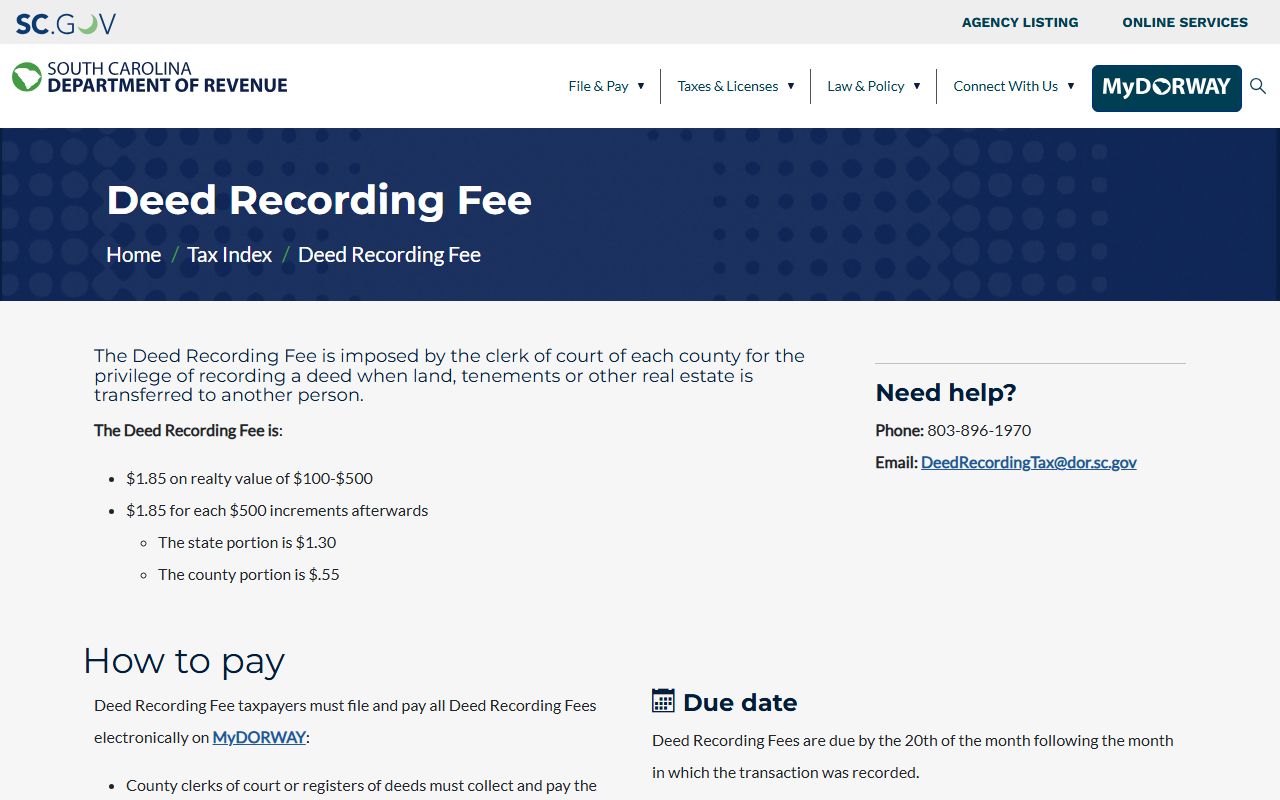
Dillon County follows the statewide fee schedule. The deed recording fee is $1.85 per $500 of the property's value. Transactions under $100 are not subject to the fee. The Clerk of Court collects the fee at the time of recording and remits the state's portion monthly through the MyDORWAY system.
The fee has two parts. The state portion is $1.30 per $500, and the county portion is $0.55 per $500. Both are collected together at closing or when you bring the deed to the Clerk's office. For detailed guidance on exemptions, gift deeds, and special situations, refer to SC Revenue Ruling #17-5 available through the SCDOR website.
Note: Deeds conveying property with a value under $100 are exempt from the deed recording fee, but the first-page recording fee still applies.
How to Find Dillon County Property Records
You can search Dillon County property records in person at the Clerk of Court office in Dillon. The office maintains a searchable index of all recorded instruments. You can look up documents by grantor name, grantee name, document type, or date range. Staff can assist with your search and locate documents on file.
The statewide portal at sclandrecords.com provides an online index for many South Carolina counties. Check whether Dillon County records are available through this portal for your date range. The portal index contains party names and a short property description for each recorded document. You can use this as a starting point before visiting the office for copies.
For a thorough title search, most buyers and lenders hire a title company or attorney. The Clerk of Court staff can pull documents and provide copies, but they cannot perform title searches or give legal advice on what the records mean. If you need help interpreting a chain of title, contact a South Carolina real estate attorney.
Note: Always confirm whether online records for Dillon County are current before relying on search results for a real estate transaction.
Documents Recorded in Dillon County
The Dillon County Clerk of Court records a wide range of real property instruments. Deeds are the most common document. They transfer ownership from one party to another. Warranty deeds, quitclaim deeds, and special purpose deeds are all filed here. Each deed must include a derivation clause under Section 30-5-35 that shows how the grantor acquired the property. The mailing address of the grantee must also appear on the deed.
Mortgages and deeds of trust secure real property loans. Lenders require recording to protect their security interest. Plats and surveys show property boundaries and are recorded when land is subdivided or a new survey is completed. Mechanic's liens, judgment liens, and tax liens are also recorded here and affect the marketability of title. Powers of attorney related to real estate transactions are filed with the Clerk as well.
Documents filed in Dillon County include:
- Warranty deeds and quitclaim deeds
- Mortgages and deeds of trust
- Plats and subdivision maps
- Mechanic's and judgment liens
- Releases and satisfactions of mortgage
- Easements and right-of-way agreements
- Powers of attorney affecting real property
North Carolina Boundary Clarification
Dillon County is one of the South Carolina counties affected by the state boundary clarification law. Section 30-5-270 of the South Carolina Code addresses this issue. The boundary between South Carolina and North Carolina was clarified effective January 1, 2017. Land in border areas that was previously believed to be in North Carolina may now be confirmed as South Carolina property.
When recording offices in affected counties encounter deeds or plats for such land, they file a Notice of State Boundary Clarification. This notice alerts title researchers that the property may have records in both states. If you are researching land near the Dillon County border with North Carolina, you may need to search records in both states to get a complete chain of title. Dillon County is one of eleven South Carolina counties where this provision applies.
Other counties bordering North Carolina that are similarly affected include Marlboro, Chesterfield, Lancaster, and Horry. Property owners and title companies in these areas should be aware that the boundary clarification may affect recorded instruments dating back before 2017.
Dillon County Property Assessment
The Dillon County Assessor's Office maintains records of property values for tax purposes. South Carolina law requires each county to conduct a countywide reassessment every five years, with a one-year extension available by county ordinance. Under Title 12, Chapter 37, property is assessed at different ratios depending on its use.
Owner-occupied primary residences qualify for the 4% legal residence assessment ratio. Other residential property, commercial land, and investment real estate is assessed at 6%. Agricultural land also qualifies for the 4% rate if it meets statutory requirements. The assessed value multiplied by the applicable millage rate determines the property tax owed each year.
Act 388 limits how much assessed value can increase between reassessments. If a property does not transfer, its taxable value cannot increase more than 15% from one reassessment to the next. This cap, often called the ATI cap, protects long-term property owners from large tax increases when market values rise sharply. When a property sells or transfers, the assessor places the property on the rolls at full fair market value the following year.
Note: If you believe your Dillon County property assessment is incorrect, you have the right to appeal to the County Board of Assessment Appeals within a set time after receiving your notice of assessment.
South Carolina Land Records Portal
The SC Land Records portal connects researchers to recorded property documents from multiple South Carolina counties.
The SC Land Records portal connects researchers to recorded property documents from South Carolina's 46 recorder districts, including Dillon County's Clerk of Court index.
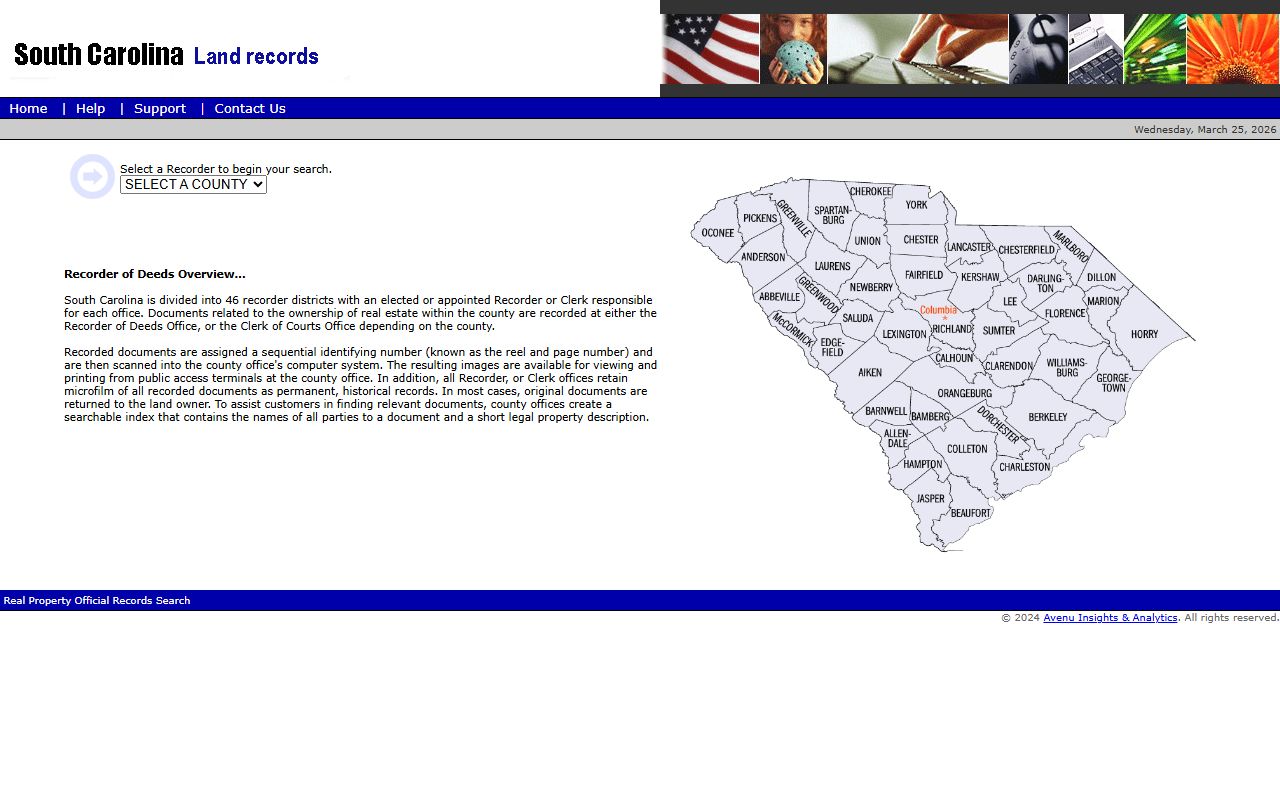
South Carolina is divided into 46 recorder districts. Each district is either a Register of Deeds office or a Clerk of Court. The portal provides a searchable index of party names and short property descriptions for documents recorded in participating counties. Dillon County's Clerk of Court assigns each recorded document a sequential reel and page number, which appears in the index. You can use this number to request a copy from the office.
The South Carolina Association of Counties coordinates county government operations across all 46 counties, including standards for property records management. For statewide information on county recording offices, this resource can help identify the right contact for any county in South Carolina.
Historical Property Records for Dillon County
The South Carolina Department of Archives and History holds historical records relevant to Dillon County land research. The department maintains state land grant records, colonial plat books, and other early documents. Dillon County was formed in 1910 from part of Marion County. Property records predating that year may be found in Marion County's recording office or in archived state records.
The South Carolina Department of Archives and History holds early plat books and land grants covering the area that became Dillon County in 1910, when it was formed from part of Marion County.
The SC Archives maintains the Surveyor General's records, including Colonial Plat Books covering 1731 through 1775, and State Plat Books from 1784 through 1868. These early plat records document original land grants and are essential for researchers tracing ownership back to the colonial period. For Dillon County land with a long history, searching archived Marion County records is often the next step after reviewing the Clerk's current index.
Under Section 30-5-90, the recording office must record every instrument in the order it is received and complete recording within thirty days of lodgment. This rule has applied consistently and means the recording dates in the index accurately reflect when documents were filed.
Nearby Counties
Dillon County borders several other South Carolina counties. If you are unsure whether a property falls in Dillon County, check the address against county boundary maps before searching records.