
Town of Lexington Deeds and Property Records
Lexington property records are maintained by the Lexington County Register of Deeds. The Town of Lexington is the county seat of Lexington County and has a population of about 22,000. All real estate instruments for Lexington properties -- deeds, mortgages, plats, and other land documents -- are recorded and indexed at the Lexington County Register of Deeds. Lexington County is among the South Carolina counties with a dedicated Register of Deeds office, making the county the primary source for Lexington deed records and property document searches. The county's website at lex-co.com provides information and online access to the recording index.
Lexington Quick Facts
Where to Find Lexington Town Property Records
All property records for the Town of Lexington are filed at the Lexington County Register of Deeds. Under Section 30-5-10 of the South Carolina Code, Lexington County maintains a dedicated Register of Deeds office as the designated recording authority for the county. Every deed, mortgage, plat, and lien for a Lexington property must be submitted here for recording. Documents are indexed under grantor and grantee names and scanned into the county's digital system.
Because Lexington serves as the county seat, the Register of Deeds is located within the town. This makes in-person access straightforward for Lexington residents and property owners. The Lexington County website at lex-co.com provides online access to the recorded instruments index and information about the Register of Deeds office. Title researchers and real estate professionals regularly use this portal to search Lexington property records without visiting the office.
The screenshot below is from the Town of Lexington website, which provides local government services, zoning information, and permit records for properties within the town.
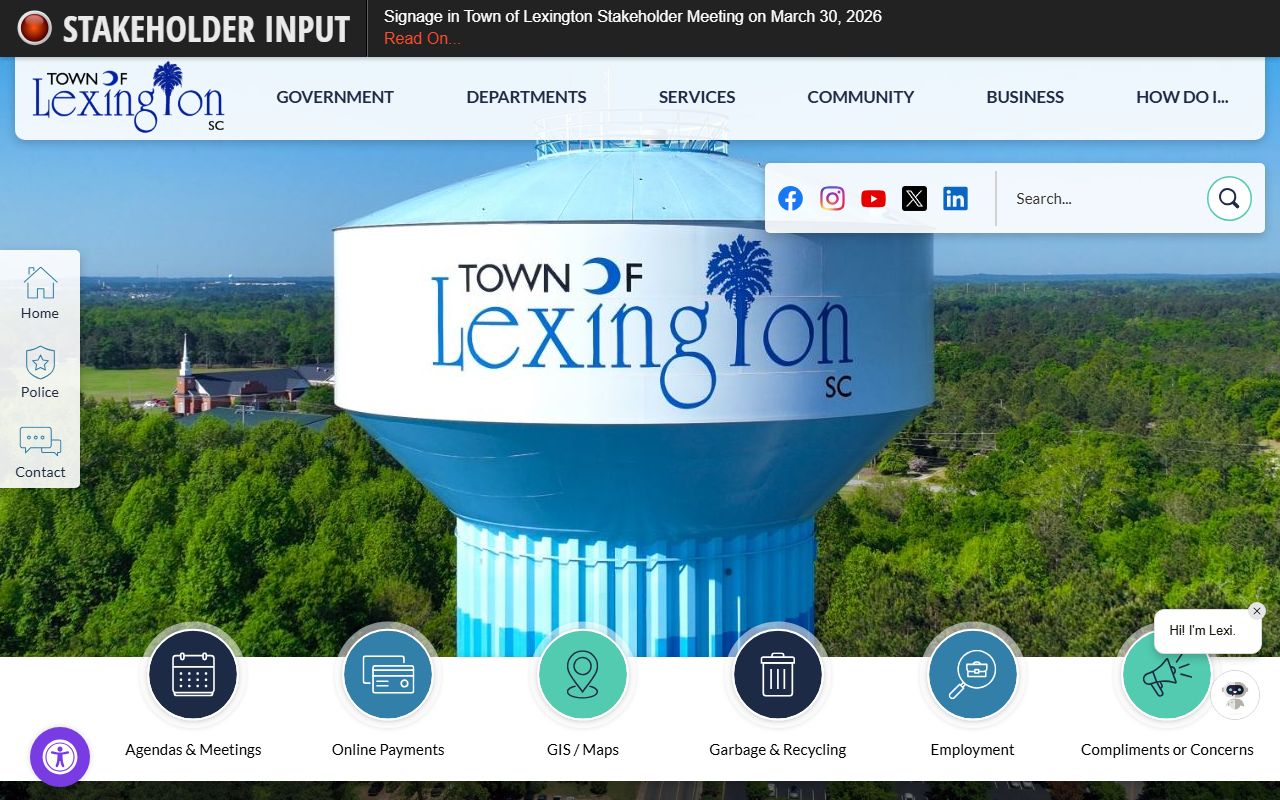
The Town of Lexington website at lexsc.com covers the local services and records maintained at the town level, including planning, zoning, and permits for Lexington properties.
| Recording Office | Lexington County Register of Deeds |
|---|---|
| County Website | lex-co.com |
| Town Website | lexsc.com |
| Statewide Portal | sclandrecords.com |
Searching Lexington Property Records Online
Lexington County's online index allows you to search recorded real estate instruments for Town of Lexington properties. Go to lex-co.com and navigate to the Register of Deeds section to access the search interface. You can look up records by grantor or grantee name and filter by document type or date range. The index returns matching instruments with the recording date, document type, and party names. Scanned images of recorded documents are available through the county's online system.
Lexington County has experienced some of the strongest population growth in the Columbia metropolitan area over the past several decades. This growth is reflected in a high volume of recorded deed and mortgage instruments at the Register of Deeds. Searching by street name or subdivision can be helpful when you are trying to locate all recorded documents for a specific Lexington neighborhood or development.
The statewide SC Land Records portal also provides access to Lexington County recorded instruments. This portal covers multiple counties and lets you search by party name with results showing a brief legal description. Using both the county index and the statewide portal together gives you the most thorough coverage when researching Lexington property records.
Note: The Lexington County Assessor's Office maintains parcel data including ownership information and assessed values, which complements the deed records at the Register of Deeds.
Types of Property Documents for Lexington
The Lexington County Register of Deeds records a full range of real estate instruments for Town of Lexington properties. Warranty deeds are the standard instrument for conveying fee simple ownership in residential and commercial sales. Quitclaim deeds appear frequently in estate transfers, family conveyances, and corrective deeds where title warranties are not provided. Both deed types are searchable in the Lexington County index by grantor and grantee name.
Mortgage instruments and deeds of trust are recorded when Lexington properties secure loans. Mortgage releases and satisfactions are filed to clear liens from title after payoff. Subdivision plats establish the legal boundaries of Lexington's residential and commercial developments. Easements, whether for utilities, drainage, or access, are also recorded and indexed as permanent components of the property record.
Additional instruments for Lexington properties include lis pendens notices, mechanic's liens, assignments of mortgage, boundary line agreements, and restrictive covenants filed by developers in Lexington's newer subdivisions. Each instrument receives a reel and page number in the county's index at the time of recording.
Lexington Town Property Assessment
The Lexington County Assessor determines the taxable value of all real property in the Town of Lexington. Under Title 12, Chapter 37 of the South Carolina Code, Lexington County must conduct a countywide reassessment every five years. The Assessor appraises parcels at fair market value and notifies property owners when assessed values change beyond the statutory threshold. Lexington town's growth and rising home values have made reassessment notifications a significant issue for many property owners in recent years.
Act 388 of 2006 limits taxable value increases to 15% between reassessment cycles for properties that have not transferred. When a Lexington property sells or changes hands in a qualifying transaction, an Assessable Transfer of Interest (ATI) occurs. The ATI resets the property's taxable value to full fair market value for the tax year following the transfer. For buyers in Lexington's active real estate market, this means the tax bill after closing will likely reflect current market value rather than the prior capped value.
South Carolina assessment ratios are 4% for owner-occupied primary residences, 4% for qualifying agricultural land, and 6% for commercial and non-primary-residence properties. Lexington town has significant residential growth alongside commercial development along its main corridors. The applicable ratio for any given Lexington property depends on how it is used and classified by the Assessor.
The image below is from the South Carolina Code Title 12, which governs property tax assessment ratios and reassessment cycles for Lexington and all other South Carolina counties.
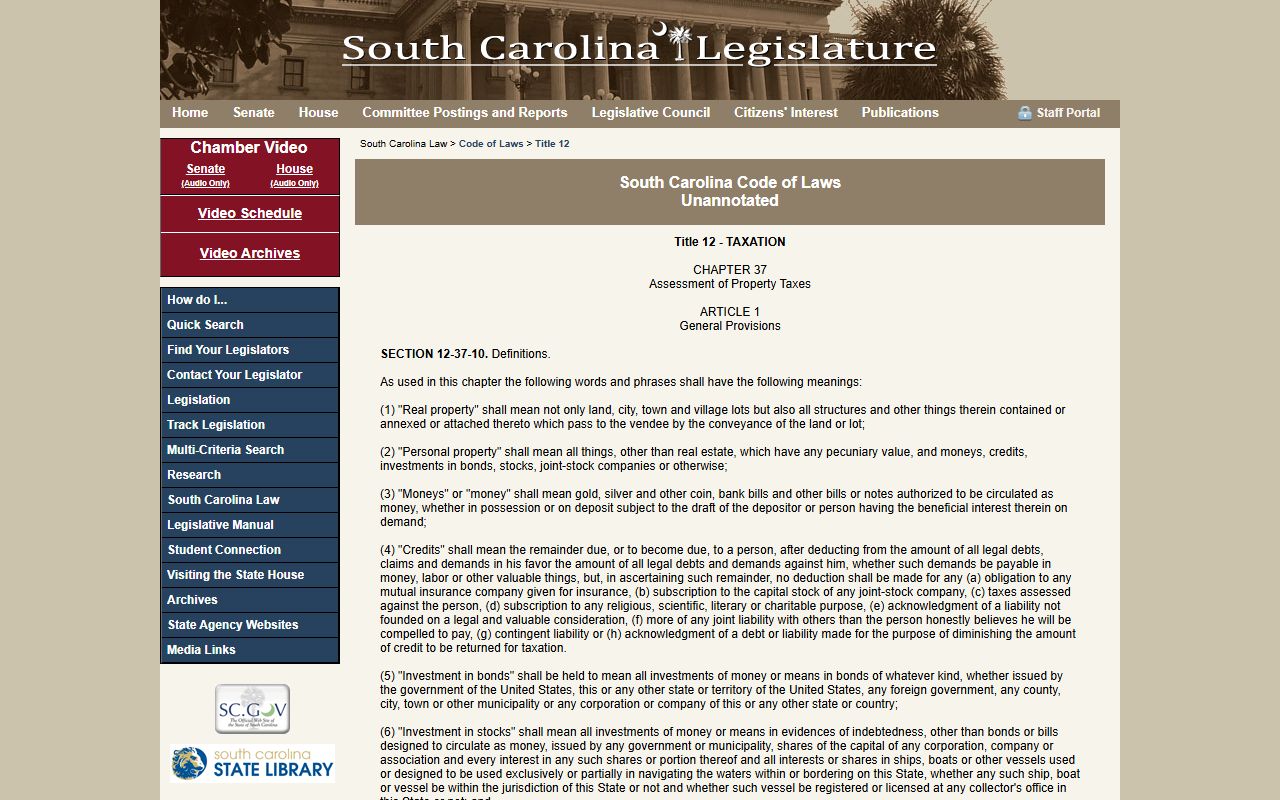
Title 12 of the South Carolina Code sets the assessment ratio rules, ATI provisions, and reassessment requirements that apply to all Lexington town properties in Lexington County.
Recording Requirements for Lexington County
Documents submitted to the Lexington County Register of Deeds must comply with Section 30-5-30 of the South Carolina Code. Acknowledgment before a notary public is required, or the instrument must be proved by affidavit of a subscribing witness. Original signatures are mandatory. South Carolina requires two witnesses on real estate instruments conveying interests in real property within the state.
Section 30-5-35 requires a derivation clause in every deed and mortgage executed after July 1, 1976. The derivation clause identifies how the grantor obtained title by citing the prior deed's book and page number. The grantee's or mortgagee's mailing address must also appear on the face of the document. All of these requirements apply to Lexington town property instruments filed with the Lexington County Register of Deeds.
The state deed recording fee from the South Carolina Department of Revenue is $1.85 per $500 of stated property value and is collected at the time of recording. The Register of Deeds remits the state's share monthly via the MyDORWAY electronic system. Under Section 30-5-90, the office must index and record all accepted documents within 30 days of receipt.
Historical Property Records in Lexington
Lexington has served as the county seat of Lexington County since the county's formation in 1785, making it one of South Carolina's older county seat communities. Property records from the county's early years through the present are maintained by the Register of Deeds. Older deed books, plat volumes, and index records from the 18th and 19th centuries are preserved in the courthouse. For older records, in-person research may be necessary to review volumes that predate the county's digital index.
For pre-county research, the South Carolina Department of Archives and History in Columbia holds land grant records and district-era plat books that predate Lexington County's formation. Lexington County was carved from the old Camden and Orangeburg Districts, and the Archives holds records from those districts as well as the Surveyor General's colonial and state plat books. These collections document the earliest land grants in the Lexington area and are essential for deep title research.
SC Land Records and Lexington County
The SC Land Records statewide portal includes Lexington County recorded instruments and provides a secondary search tool for Town of Lexington property records. The portal lets you search by party name and displays results with the document type, recording date, and a brief legal description. This is particularly useful for Lexington researchers who want to cross-reference a result or search across multiple South Carolina counties at once.
Lexington County's recording system assigns a sequential reel and page number to each document when it is recorded. The original instrument is returned to the submitting party after the Register of Deeds creates the scanned image and microfilm copy that serve as the official record. Certified copies can be ordered from the Register of Deeds by visiting the office or through the county's contact channels. The reel and page number from any recorded deed is the key reference needed to order a certified copy.
The image below is from the South Carolina Judicial Branch, whose court records often interact with Lexington town property records through foreclosure and probate proceedings.
The SC Judicial Branch at sccourts.org handles court records that affect Lexington property titles, including foreclosure proceedings and probate transfers of real estate.
Lexington County Property Records
The Town of Lexington is the county seat of Lexington County. All property recordings for Lexington town properties are maintained by the Lexington County Register of Deeds. For full county-level information, recording procedures, and assessment resources, visit the Lexington County property records page.
Nearby South Carolina Cities
Cities near Lexington are served by Lexington County and neighboring recording offices. Choose a city to find property records in that area.